
Gas Market & Policy
A Tiered Fuel Adjustment Changes Who Carries the Risk
Malaysia is studying a tiered Automatic Fuel Adjustment (AFA) mechanism for 2027, with the aim of providing fairer and more targeted protection to electricity consumers.
The intention is understandable. When coal, gas and foreign-exchange costs rise, households need protection from sudden bill shocks.
Yet tiering cannot make the underlying fuel cost disappear. It changes who pays, how much they pay and when the cost appears. That distinction matters.
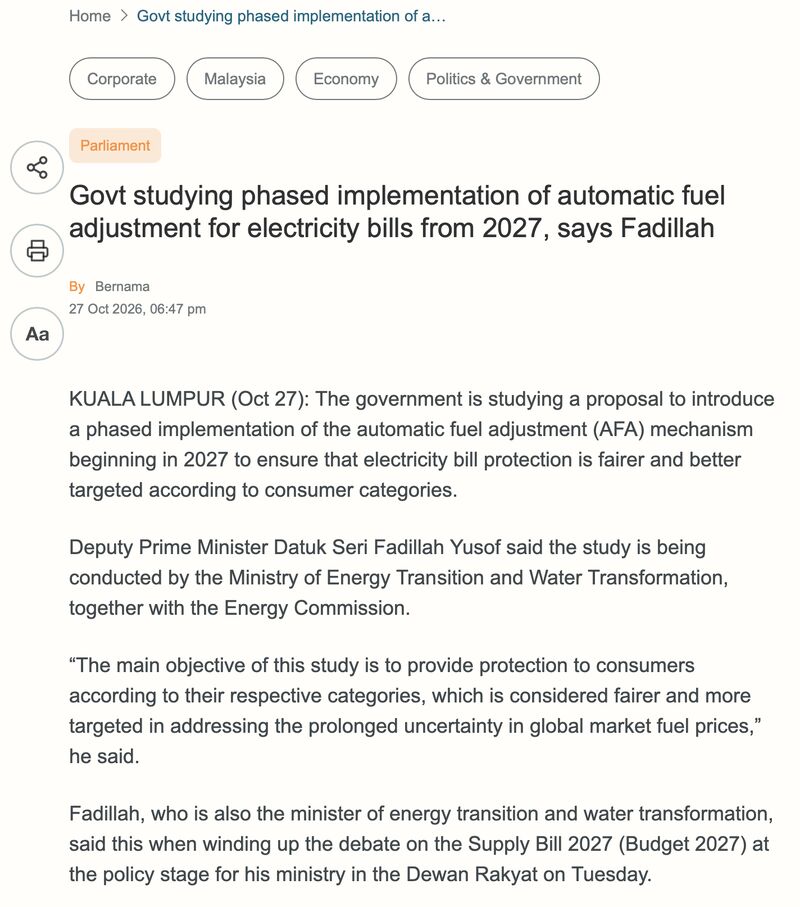
Under the current tariff framework, AFA reflects changes between forecast and actual generation costs. If one group is shielded from those changes, the balance must eventually sit somewhere else:
- in another customer’s electricity bill
- in the Kumpulan Wang Industri Elektrik
- on TNB’s balance sheet or
- in the national budget
Every ringgit still needs an accountable home.
Consumption bands offer a convenient way to target relief, though electricity usage is an imperfect measure of financial need. A large lower-income family, a multigenerational household or a home using medical equipment may consume more electricity than a wealthy individual living alone.
A durable tiered AFA therefore needs to answer several questions clearly:
- Is protection based on consumption, income or both?
- Do higher-use customers pay only their own fuel costs, or also cross-subsidise others?
- Who finances temporary cost deferrals?
- Will support reduce automatically when fuel prices fall?
- How do we avoid a sharp “cliff effect” at the boundary between tiers?
The design must also preserve the incentive to use electricity efficiently.
In my earlier article, “Malaysia’s Cheapest New Source of Energy”, I argued that the cheapest unit of energy is often the one we no longer need to generate. Targeted protection and energy efficiency should therefore reinforce each other. Support should protect vulnerable consumers without making the true cost of energy invisible.
A well-designed tiered AFA can improve fairness. Its credibility will depend on three disciplines: accurate targeting, transparent cost allocation and continued incentives to reduce structural demand.
Fuel-price volatility cannot be legislated away.
The real policy choice is who carries the risk, how visibly it is carried and whether the system helps consumers reduce that exposure over time.
Free Briefing
Malaysia Gas Market Reform: A Leadership Briefing
The end of the Gas Framework Agreement, Third Party Access, gas shippers and CRESS in one read, with ten questions for your leadership team.
Working Through a Similar Question?
Energy Systems Advisory helps leaders understand how market, regulatory and commercial changes affect the wider gas system before a decision is made.
Newsletter
Get New Insights by Email
Analysis of gas markets, energy systems and strategy, sent when a new article is published.
Or subscribe directly on Substack.