
Gas Market & Policy
Why Gas Curtailment Next Door Matters to Malaysia
Indonesia has not stopped supplying gas to Malaysia and Singapore, as some headlines and social-media posts appear to suggest.
What has happened is more specific.
On 24 October, Indonesia reduced pipeline-gas exports to Singapore by 31 MMSCFD i.e. approximately 9% of Singapore’s pipeline supply from Indonesia. The gas is being redirected to meet electricity demand in Batam, Bintan and Sumatra.
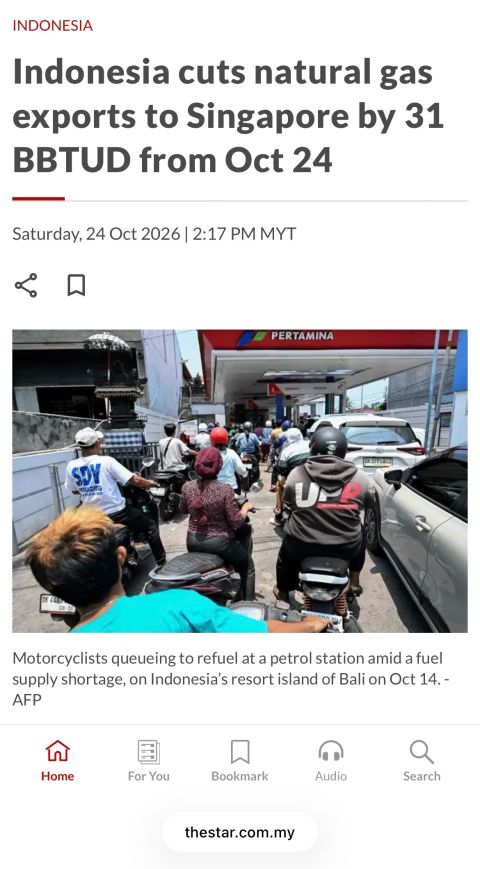
Singapore’s Energy Market Authority (EMA) estimates the effective reduction at 17 BBTUD for 18 days, equivalent to less than 2% of the country’s total daily gas demand. Singapore can also draw on LNG as an alternative source.
There is presently no confirmed interruption to Malaysia. But I do not think Malaysia should dismiss it as someone else’s problem.
Indonesia has separately indicated that it may reconsider renewing gas-export contracts as its domestic requirements grow. Singapore’s existing Indonesian pipeline contracts expire at the end of 2028.
The development highlights a distinction that matters across energy markets:
A pipeline provides physical connectivity. It does not guarantee that gas will always remain available for export.
Regional gas security rests on three separate conditions:
- Infrastructure capable of transporting gas
- Commercial contracts securing the molecules
- The exporting country’s continuing ability and policy willingness to supply them
The first two may remain intact while the third changes.
For Malaysia, the immediate supply impact appears negligible. The strategic signal is more significant.
Peninsular Malaysia is preparing for rising electricity demand, greater gas-fired generation and the possibility of declining domestic production towards the end of the decade. LNG imports may therefore become increasingly important.
In that environment, regasification capacity, diversified LNG procurement and flexible supply arrangements should not be assessed solely by their immediate utilisation rates.
RGT-3, for example, is partly about additional capacity. More importantly, it creates optionality: the ability to respond when an established supply route becomes constrained, expensive or politically uncertain.
Optionality may appear costly while the system is comfortable. Its value becomes visible when circumstances change.
Energy resilience is not the ability to predict exactly which supplier may reduce supply. It is ensuring that the system still has credible choices when one does.
The Indonesian curtailment may be small. The lesson for regional energy planning is not.
Free Briefing
Malaysia Gas Market Reform: A Leadership Briefing
The end of the Gas Framework Agreement, Third Party Access, gas shippers and CRESS in one read, with ten questions for your leadership team.
Working Through a Similar Question?
Energy Systems Advisory helps leaders understand how market, regulatory and commercial changes affect the wider gas system before a decision is made.
Newsletter
Get New Insights by Email
Analysis of gas markets, energy systems and strategy, sent when a new article is published.
Or subscribe directly on Substack.