
Energy Systems & Infrastructure
Malaysia's Cheapest New Source of Energy
Malaysia may have just announced its cheapest new source of energy.
It is not gas, solar, hydro or nuclear.
It is the energy we no longer need to consume.
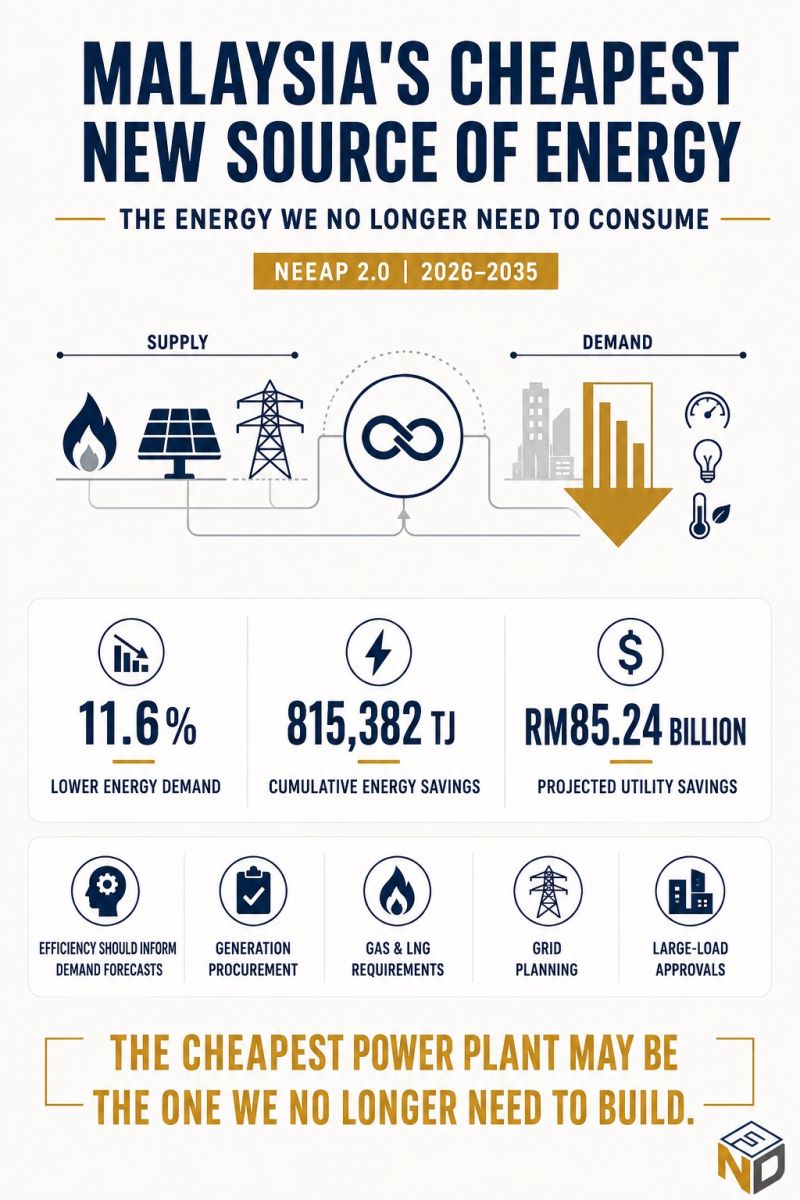
Under the National Energy Efficiency Policy and Action Plan 2026 to 2035, Malaysia aims to reduce national energy demand by 11.6% against business-as-usual projections.
This could deliver cumulative savings of 815,382 terajoules, RM85.24 billion in utility costs and 26.1 million tonnes of avoided carbon emissions.
These are encouraging numbers. They also raised a question in my mind.
Will these savings influence what Malaysia builds next?
In my earlier articles on gas-market reform, CRESS, data centres and ERI 2026, I have tried to explore one recurring idea: perhaps we need to view energy as one interconnected system.
Gas supply affects power generation. Electricity-market design shapes renewable investment. Data-centre demand influences generation, grid and fuel requirements. Each decision moves another piece on the energy chessboard.
Energy efficiency deserves a place on that same chessboard.
When demand rises, our natural response is to add supply, more power plants, LNG imports, solar farms, batteries and grid infrastructure.
Much of this may be necessary. At the same time, every unit of avoidable demand removed could mean less fuel to procure, fewer emissions to manage and potentially less capacity to build.
In some circumstances, the megawatt we do not need may be as valuable as the megawatt we add.
It may therefore be useful for the projected 11.6% reduction to inform:
- electricity and gas demand forecasts
- generation-capacity procurement
- gas allocation and LNG requirements
- transmission and distribution planning
- approvals for data centres and other large energy users
Otherwise, we may celebrate RM85.24 billion in projected savings while continuing to design the system as though none of those savings will materialise.
The first action plan exceeded its electricity-saving target, achieving 60,886 GWh against 52,233 GWh. This gives us reason to be optimistic.
The next opportunity, in my view, is to connect verified savings with investment decisions.
Can efficiency defer a grid upgrade in a constrained location? Can lower peak demand reduce the need for new generation?
Should large consumers be assessed only by the power they request or also by the economic value produced from every unit consumed? And how do we independently verify the savings?
In my ERI 2026 wishlist, I suggested that Malaysia’s energy conversation could move from individual initiatives towards a clearer understanding of how the whole system works together.
NEEAP 2.0 presents another opportunity to do this.
Malaysia will still need new energy supply. But perhaps supply and demand can be planned more closely as one integrated system.
After all, our cheapest power plant may ultimately be the one we no longer need to build.
Working Through a Similar Question?
Energy Systems Advisory helps leaders see the supply, demand and infrastructure dependencies behind a decision, and where the risk sits.
Newsletter
Get New Insights by Email
Analysis of gas markets, energy systems and strategy, sent when a new article is published.
Or subscribe directly on Substack.