
Gas Market & Policy
RFP for Malaysia Power Study
Last week, over lunch, a friend asked what I would suggest for the study on the post-Gas Framework Agreement (GFA) era, given the opportunity.
I had written earlier about TNB’s Request for Information (RFI) for this exercise. It has now reached the RFP stage.
My response was simple. Start by understanding the system.
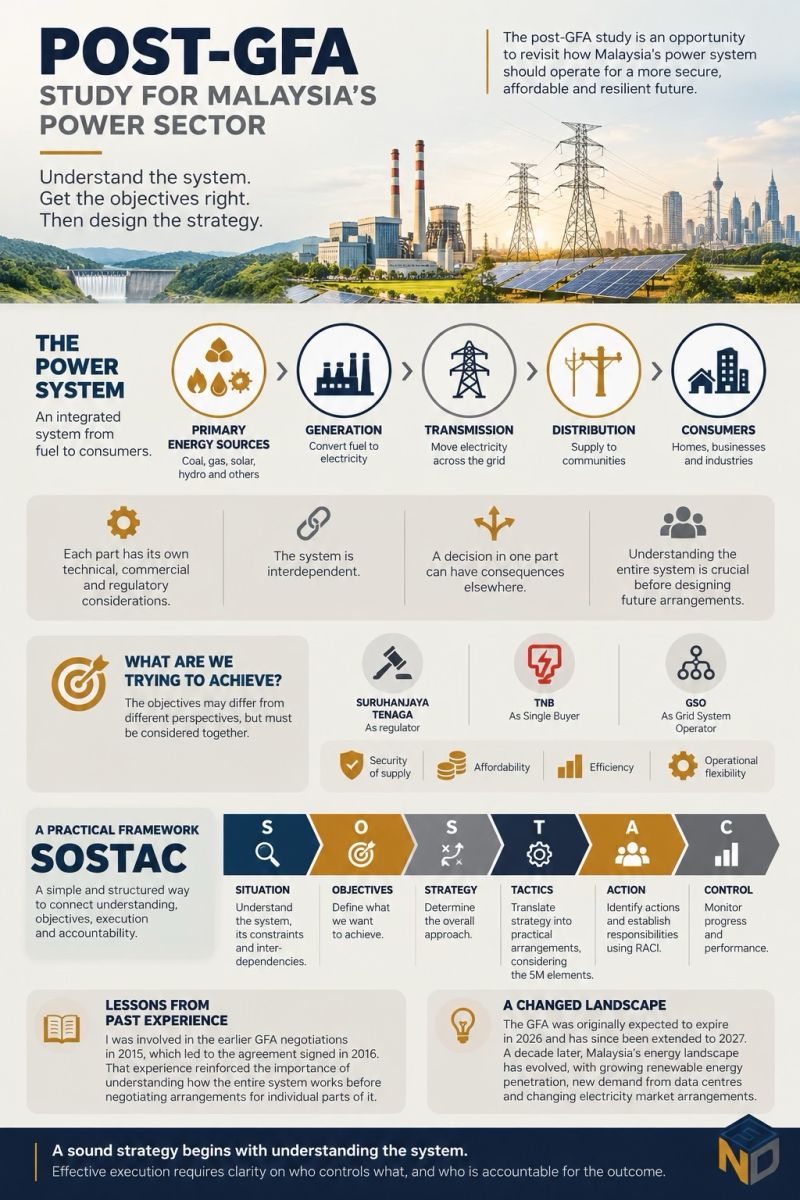
Understand its operating philosophy, constraints and interdependencies, from primary energy sources such as coal, gas, solar and hydro, through generation, transmission and distribution all the way to electricity consumers.
Each part has its own technical, commercial and regulatory considerations. A decision in one part may have consequences elsewhere.
Then comes the next question. What exactly are we trying to achieve?
The objectives may differ from the perspectives of Suruhanjaya Tenaga as regulator, TNB as Single Buyer and the Grid System Operator (GSO).
Security of supply, affordability, efficiency and operational flexibility must be considered together.
Once the objectives are clear, the strategy and tactical arrangements can follow.
My friend then asked, “Who should be accountable for the whole system?”
I replied with another question. “Who is actually in control?”
Control comes with accountability.
Different parts of the system have different responsibilities, decision rights and levels of control. Accountability should reflect these arrangements.
This brings me back to systems thinking. One framework I have found particularly useful over the years is SOSTAC.
Although originally developed for marketing, I have adapted it, with some adjustments, for strategic and operational planning.
- S, Situation: Understand the system, its constraints and interdependencies
- O, Objectives: Define what we want to achieve
- S, Strategy: Determine the overall approach
- T, Tactics: Translate strategy into practical arrangements, taking into account the 5M elements
- A, Action: Identify actions and establish responsibilities using RACI
- C, Control: Monitor progress and performance
The beauty of SOSTAC, at least for me, is its simplicity. It provides a structured way to connect understanding, objectives, execution and accountability.
I had the opportunity to be involved in the earlier GFA negotiations in 2015, which eventually led to the agreement signed in 2016.
That experience taught me the importance of understanding how the entire system works before negotiating arrangements for individual parts of it.
The GFA was originally expected to expire in 2026 and has since been extended to 2027.
A decade later, Malaysia’s energy landscape has changed considerably, with growing renewable energy penetration, new demand from data centres and evolving electricity market arrangements.
Just sharing here a perspective from my earlier experience and a recent conversation with a friend.
A sound strategy begins with understanding the system. Effective execution requires clarity on who controls what and who is accountable for the outcome.
Free Briefing
Malaysia Gas Market Reform: A Leadership Briefing
The end of the Gas Framework Agreement, Third Party Access, gas shippers and CRESS in one read, with ten questions for your leadership team.
Working Through a Similar Question?
Energy Systems Advisory helps leaders understand how market, regulatory and commercial changes affect the wider gas system before a decision is made.
Newsletter
Get New Insights by Email
Analysis of gas markets, energy systems and strategy, sent when a new article is published.
Or subscribe directly on Substack.