
Energy Systems & Infrastructure
A Light Sunday Reflection on Malaysia Energy Transition
When we discuss energy transition, the conversation often centres on what we need more of. More solar. More batteries. More electric vehicles. More data centres powered by green energy.
All are important.
Yet having the ingredients does not always mean the whole system is ready.
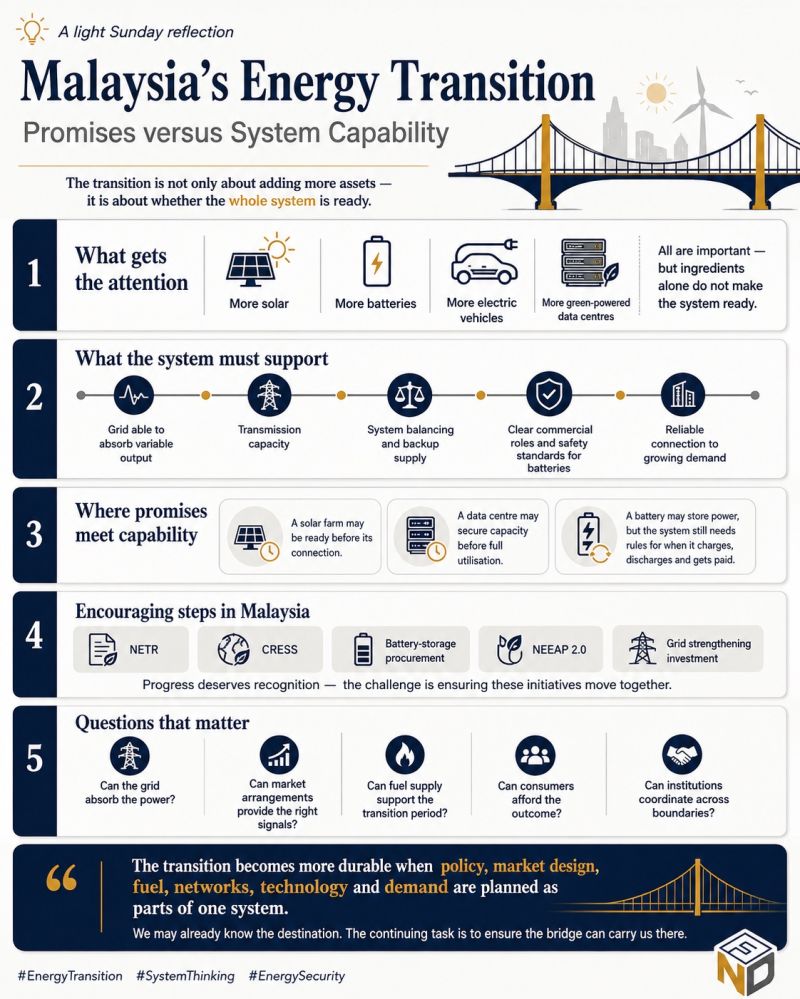
Solar needs a grid capable of managing variable output. Batteries require clear roles, safety standards and commercial arrangements. Renewable contracts still depend on transmission capacity, system balancing and backup supply.
Meanwhile, data centres and advanced manufacturing are bringing large new loads, sometimes faster than conventional planning cycles were designed to accommodate.
This, perhaps, is where transition promises begin to meet system capability.
Malaysia has taken several encouraging steps through the NETR, CRESS, battery-storage procurement, NEEAP 2.0 and substantial investment to strengthen the grid. There is much to welcome.
The less visible challenge is ensuring that these different initiatives move together, at a pace the overall system can support.
In my recent article, I shared the thought that Malaysia’s cheapest new source of energy may be the energy we no longer need to consume. That reflection also seems relevant here.
Progress may not be measured only by how much new capacity we announce. It may also depend on whether we can connect it when needed, balance it when the sun is not shining, deliver it to where demand is growing, keep electricity reliable and affordable and avoid building too far ahead of demand that may take longer to materialise.
A solar farm may be ready before its connection. A data centre may secure capacity before reaching full utilisation. A battery may store electricity, but the system still needs to determine when it should charge, discharge and be paid.
These details rarely receive the same attention as major announcements. Yet they may ultimately shape whether the transition succeeds.
From my limited observation, perhaps the more useful measure of progress is not simply the number of initiatives launched, but the capability created between them.
Can the grid absorb the power? Can market arrangements provide the right signals? Can fuel supply support the transition period? Can consumers afford the outcome? And can institutions coordinate decisions that cross their traditional boundaries?
Malaysia will continue to need renewable energy, storage and modern infrastructure. The direction is clear and the progress deserves recognition.
My 2cents view is that the transition becomes more durable when policy, market design, fuel, networks, technology and demand are planned as parts of one system.
We may already know the destination. The continuing task is to ensure the bridge can carry us there.
Working Through a Similar Question?
Energy Systems Advisory helps leaders see the supply, demand and infrastructure dependencies behind a decision, and where the risk sits.
Newsletter
Get New Insights by Email
Analysis of gas markets, energy systems and strategy, sent when a new article is published.
Or subscribe directly on Substack.