
Energy Systems & Infrastructure
Renewable Energy Does Not Have to Remain as Electricity
Something caught my attention while reading about the development of green ammonia for maritime fuel.
I have always looked at renewable energy largely from the electricity side.
Generate renewable power. Connect it to the grid. Move the electrons to where demand is.
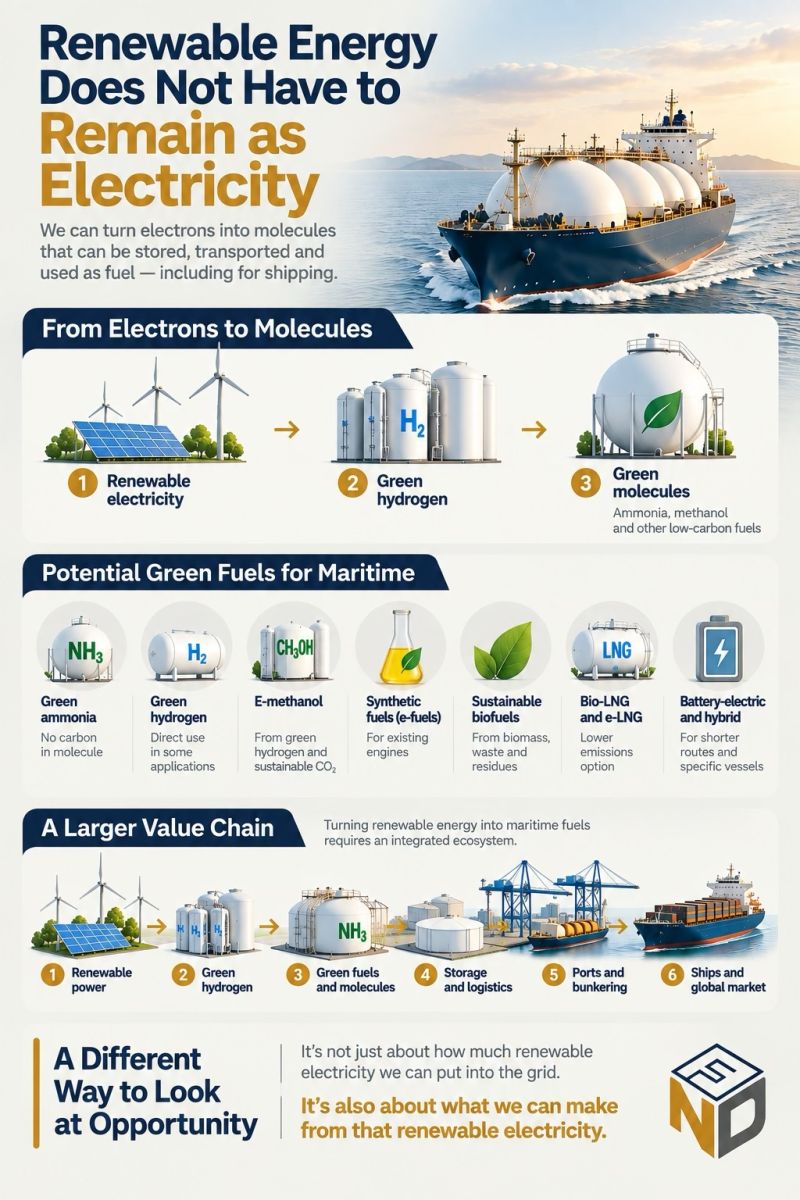
But renewable electricity does not necessarily have to remain as electricity.
We can turn electrons into molecules. The simplest example is green hydrogen.
Renewable electricity powers an electrolyser to produce hydrogen. That hydrogen can then become a building block for other fuels. Add nitrogen and we can produce green ammonia.
Combine green hydrogen with a sustainable source of CO₂ and we can produce e-methanol.
Go further and there are synthetic fuels or e-fuels. Alongside them are sustainable biofuels, bio-LNG and potentially e-LNG.
For maritime transport, I don’t think we know yet which pathway will eventually dominate.
Different vessels, routes and applications may require different solutions. Battery-electric may work for some shorter routes, while ammonia, methanol, hydrogen or sustainable fuels could play different roles elsewhere.
What interests me more is the system behind the fuel.
Take green ammonia:
Renewable power → Green hydrogen → Green ammonia → Storage → Bunkering → Ships
Suddenly, renewable energy is no longer only a generation story. It becomes an industrial story.
This reminds me of something I have been thinking about in our energy transition.
We often ask: How much renewable energy can our grid accommodate?
That remains an important question. Grid capacity, intermittency, system balancing and demand all matter.
But perhaps there is another question worth asking: What can we make from our renewable energy?
Once electricity becomes molecules, renewable resources can potentially be stored, transported and connected to markets beyond the electricity grid.
Of course, the economics still have to work.
Green hydrogen and its derivatives require competitive renewable electricity. Conversion involves energy losses. New infrastructure is required. Producers need credible long-term buyers, while shipowners need confidence that fuel will be available.
The whole value chain has to move together.
Malaysia sits along one of the world’s busiest maritime corridors. We also have ports, industrial infrastructure and decades of experience handling energy and molecules.
I am not suggesting that green ammonia will necessarily be the answer.
But I think this development is worth watching.
Perhaps the next chapter of our energy transition is not simply about producing more renewable electrons.
It is about understanding what those electrons can become, and what new industries we can build around them.
Could it also be used as an alternative green power supply to data centres? Perhaps worth exploring.
Working Through a Similar Question?
Energy Systems Advisory helps leaders see the supply, demand and infrastructure dependencies behind a decision, and where the risk sits.
Newsletter
Get New Insights by Email
Analysis of gas markets, energy systems and strategy, sent when a new article is published.
Or subscribe directly on Substack.