
Energy Systems & Infrastructure
The ASEAN Power Grid: How Malaysia Can Capture Value?
Singapore has granted conditional approval for up to 1.3GW of low-carbon electricity from Vietnam and Malaysia, targeted to begin in 2035.
The proposed corridor would combine offshore wind from Vietnam with solar and battery storage in Malaysia, supplying both Malaysia and Singapore.
It is an important step forward. But conditional approval is not yet a power-purchase agreement, financing, final investment decision or operating project. Approvals across all jurisdictions, bankable contracts and further development work are still required.
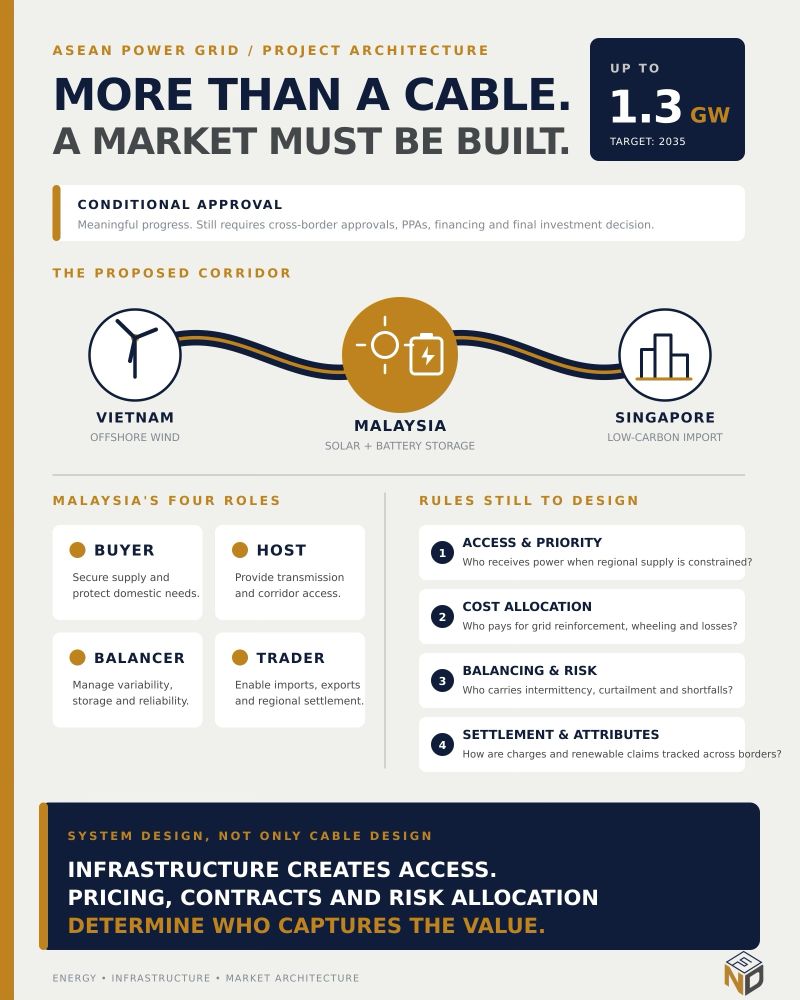
The harder task is not simply connecting three countries with cables. It is establishing the commercial and regulatory architecture that allows three electricity systems to function as one corridor.
Malaysia will not be merely a transit country. We could simultaneously become a buyer, infrastructure host, system balancer and energy trader.
That means answering practical questions:
- How much electricity will Malaysia retain, and at what price?
- Who pays for transmission reinforcement and electrical losses?
- Who carries intermittency, curtailment and balancing risk?
- Are capacity rights firm or interruptible when supply is constrained?
- How will renewable attributes be traced across borders?
These questions echo a principle I have raised in my earlier writing on gas TPA and CRESS: infrastructure creates access, but pricing, contracts and risk allocation determine whether access becomes a functioning market.
My recent article on Indonesia’s gas curtailment made a related distinction. Physical connectivity does not override domestic priorities. When supply tightens, each country will first protect its own system.
This is why Singapore’s parallel investments matter. While advancing renewable imports, it is also adding new gas-fired plants, expanding LNG regasification, investing in its grid and increasing energy storage.
That is not a contradiction. It is system design.
The same logic applies to Malaysia. As I argued in discussing RGT-3, resilience comes from optionality: having credible alternatives before the system is under pressure.
The ASEAN Power Grid could give Malaysia more than imported electricity. Properly structured, it could provide trading capability, stronger infrastructure and greater regional influence.
But Malaysia’s strategic value will not come merely from hosting the cable. It will come from shaping transparent rules for access, pricing, balancing and risk.
The cable connects markets. The architecture determines who captures the value.
Working Through a Similar Question?
Energy Systems Advisory helps leaders see the supply, demand and infrastructure dependencies behind a decision, and where the risk sits.
Newsletter
Get New Insights by Email
Analysis of gas markets, energy systems and strategy, sent when a new article is published.
Or subscribe directly on Substack.