
Energy Systems & Infrastructure
The Next Phase of Malaysia's Data Centre Story Is on Capability
In an earlier article, I wrote that a data centre is not merely a digital project. It is an energy system..
It requires electricity, grid capacity, fuel security, renewable energy, water, cooling, connectivity and reliable infrastructure working together.
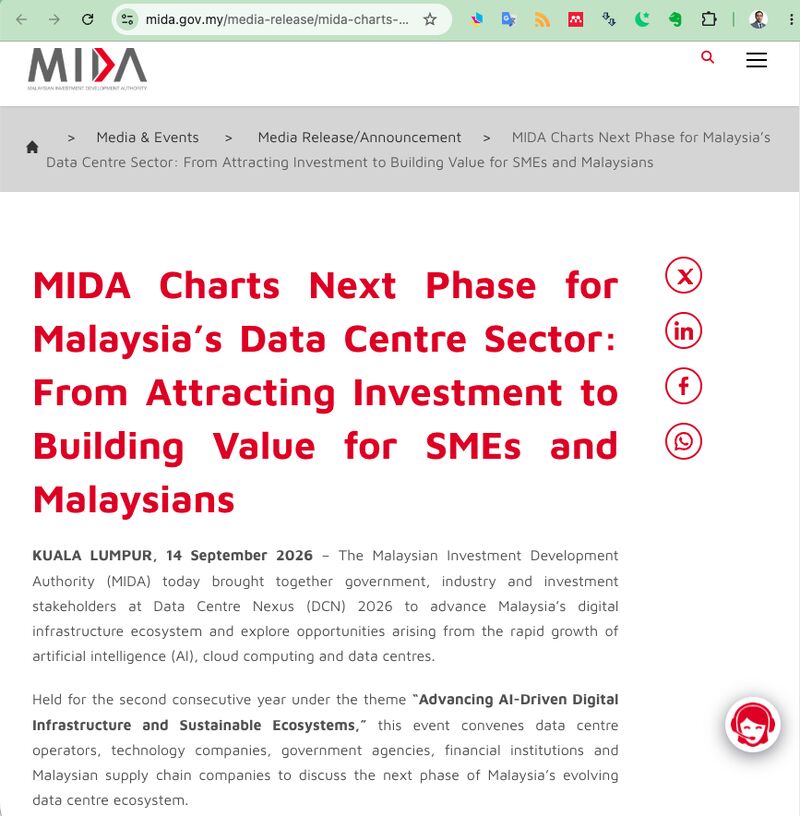
MIDA’s recent announcement on Malaysia’s data centre sector brings another important dimension to that discussion. Malaysia recorded RM385.7 billion in data-centre-related investments between 2021 and the first half of 2026. Electricity demand from the sector is projected to exceed 5,000 MW by 2035.
Those numbers demonstrate scale. But scale is only the first chapter.
The next question is not simply how many data centres Malaysia can attract. It is how much lasting capability Malaysia can build around them. A data centre may be located in Malaysia, consume Malaysian electricity, use Malaysian water and depend on Malaysian land, grid and telecommunications infrastructure. But that does not automatically mean the wider economic value remains in Malaysia.
The deeper opportunity lies in the ecosystem surrounding the data hall. Engineering and construction. Electrical and cooling systems. Energy management and water efficiency. Telecommunications and cybersecurity. Operations, maintenance and logistics. Software, cloud services and AI applications.
This is where Malaysian companies, particularly SMEs, should progressively move from supplying basic services to developing specialised capabilities. Local participation should not be measured only by how many purchase orders are awarded locally.
MIDA’s business-matching initiative, involving 14 data centre companies and 51 local vendors, is an encouraging step. But building a durable ecosystem will require more than introductions.
Capability gaps must be identified. Procurement opportunities must become more visible. Partnerships should include knowledge development. Financing and certification pathways must help credible local companies meet global standards. This is not about forcing localisation for its own sake. Data centres operate in a global and highly competitive industry. It is about ensuring that Malaysia does not remain only the place where infrastructure is built and resources are consumed.
In my earlier article, I asked what energy architecture Malaysia must build so that digital growth strengthens the national energy system. The next question is what economic architecture we must build so that the same growth strengthens Malaysian businesses, talent and innovation.
Design the energy system around the data centre. Then design the economic ecosystem around the investment.
Working Through a Similar Question?
Energy Systems Advisory helps leaders see the supply, demand and infrastructure dependencies behind a decision, and where the risk sits.
Newsletter
Get New Insights by Email
Analysis of gas markets, energy systems and strategy, sent when a new article is published.
Or subscribe directly on Substack.