
Gas Market & Policy
Third Party Access and the Discipline of Open Infrastructure
In my earlier articles, I wrote about the Gas Framework Agreement, post-GFA and gas-fired power plants, and about PGU, PGCC, GSO and the Single Buyer.
Each article points to the same idea: gas-to-power is not one contract. It is a system.
This time, the focus is Third Party Access, or TPA.
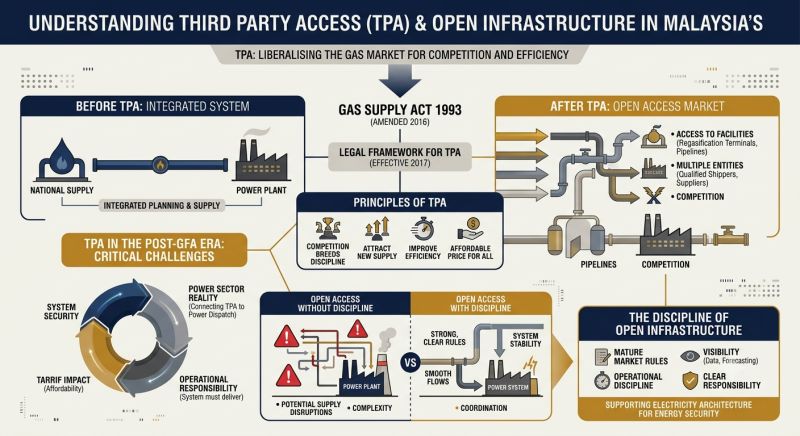
Suruhanjaya Tenaga explains that one objective of the Economic Transformation Program was to liberalise Malaysia's gas market. One way to achieve this was through TPA, where third parties may access gas facilities they do not own or operate. The Gas Supply Act 1993 was amended in 2016 and came into effect in 2017 to provide the legal framework for TPA.
This was an important shift. Before market liberalisation, gas infrastructure was largely understood through an integrated system lens. The same ecosystem planned, supplied, transported and managed gas for national requirements.
TPA changed the language. It introduced access. It introduced multiple entities. It introduced competition. It opened the possibility for qualified parties to utilise regasification terminals, transmission pipelines and distribution pipelines under regulated terms.
Access Is Also an Operational Responsibility
In principle, this is good. Competition can create discipline. Access can attract new supply. Market participation can improve efficiency.
But in gas, access is never just a commercial idea. It is also an operational responsibility. A party may have gas. A shipper may have a contract. A customer may need supply. The system must be able to deliver. And, another important element, at an affordable price for all these services and gas molecules.
That is why TPA must be understood carefully in the post-GFA era. If gas supply to the power sector becomes more market-based, TPA will become one of the critical foundations. But open access without system discipline can create new complexity. A supply disruption to a power plant can become a system security issue.
Openness Cannot Sit Alone
This is why post-GFA design must connect TPA with power-sector reality. Pipeline access cannot sit alone. Power dispatch cannot sit alone. Tariff impact cannot sit alone. They must speak to each other.
The real challenge is not whether Malaysia should have a more open gas market. The real challenge is how to make openness work without losing coordination, and at an affordable price.
A mature market needs rules. But it also needs visibility, data, forecasting, operational discipline and clear responsibility.
TPA is not merely about allowing more parties into the system. It is about making sure more parties can participate without weakening the system.
That is the discipline of open infrastructure which supports the electricity architecture for energy security.