
Gas Market & Policy
What TNB's Latest RFI Tells Us About Malaysia's Gas Market
In previous articles, I wrote about Gas Third Party Access, the Gas Framework Agreement and, more recently, AQPS.
Together, they tell the story of how Malaysia's gas market has evolved.
This week, another piece of that story quietly emerged. TNB has issued a Request for Information (RFI) to develop its strategy across the gas supply value chain. While it is not yet a tender, the RFI seeks industry input to shape a future strategic study.
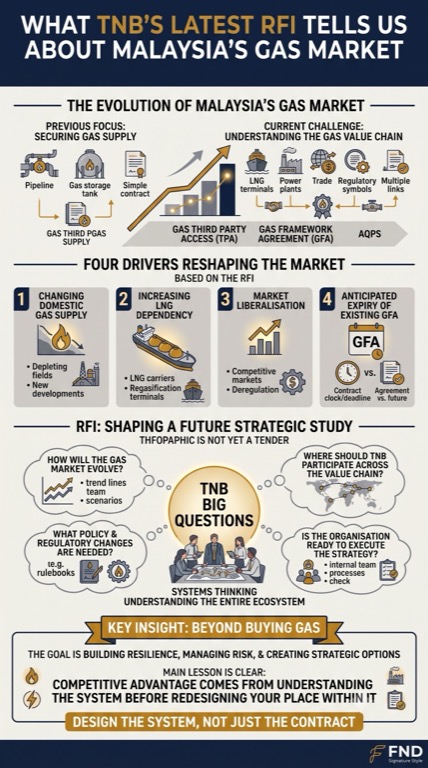
On the surface, it looks like a procurement exercise. I believe it is much more than that.
Four Drivers Reshaping the Market
The opening paragraphs highlight four powerful drivers reshaping Malaysia's gas market: changing domestic gas supply, increasing LNG dependency, market liberalisation and the anticipated expiry of the existing GFA.
Those four developments explain why the conversation is changing.
For years, the challenge was largely about securing gas supply. Today, the challenge is understanding the entire gas value chain, from supply and LNG to commercial structures, regulation and strategic positioning.
Four Bigger Questions
Interestingly, TNB is not merely asking consultants to study the market. The RFI asks four much bigger questions:
- How will the gas market evolve?
- Where should TNB participate across the value chain?
- What policy and regulatory changes will be needed?
- Is the organisation ready to execute that strategy?
That is systems thinking.
Rather than optimising one contract or one asset, the objective is to understand how every part of the gas ecosystem connects and where TNB should position itself in a rapidly evolving market.
Beyond Buying Gas
To me, this is the most significant signal in the document. The discussion is no longer centred on buying gas. It is about building resilience, managing risk and creating strategic options across the value chain.
Whether you work in gas, electricity, infrastructure or regulation, the lesson is the same. When an industry enters structural transition, competitive advantage no longer comes from negotiating a better contract alone. It comes from understanding the system before redesigning your place within it.
Perhaps that is the real significance of this RFI. It is less about appointing a consultant. It is more about asking the right questions before the next chapter of Malaysia's gas market begins.
Markets evolve. Contracts expire. Strategy begins by understanding the system.
Design the system, not just the contract.