
Energy Systems & Infrastructure
Regasification and the New Complexity of Gas-to-Power
In my earlier articles, I wrote about GFA, post-GFA, and the Allocated Quantity to the Power Sector, and about Third Party Access and the role of the Gas Shipper.
Each part tells the same story. Gas-to-power is not one contract. It is an ecosystem, which requires systemic thinking to understand and find solutions.
This time, I want to touch on regasification.
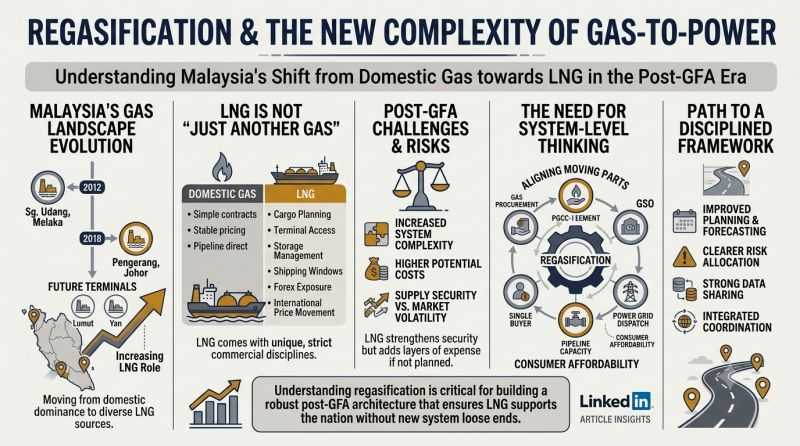
When Malaysia developed its first LNG regasification terminal in Sungai Udang, Melaka, it marked an important shift. Before that, gas supply to the power sector was largely seen through the lens of domestic gas. With regasification, LNG entered the Peninsular Malaysia gas system. That changed the equation.
Later, Pengerang added another regasification point in Johor. Now, with recent announcements on new regasification terminals in Lumut and Yan, the direction is clearer: Malaysia is preparing for a gas system where LNG will play a bigger role.
LNG Is Not "Just Another Gas"
This is important for post-GFA discussion, because LNG is not just "another source of gas." It comes with a different commercial discipline.
LNG requires cargo planning, terminal access, storage management, regasification capacity, shipping windows, foreign exchange exposure, international price movement and strict contractual commitments. Domestic gas and LNG do not behave the same commercially.
LNG can strengthen supply security. It can diversify sources. It can support demand growth. But it can also make the gas-to-power system more complex and expensive if not planned properly.
This is why post-GFA cannot be discussed only as a replacement of an old framework. It must be discussed as a new architecture for a more LNG-dependent future.
Why This Needs System-Level Thinking
If gas for power becomes more LNG-linked, the system must answer harder questions. These questions cannot be left to individual contracts alone. They need system-level thinking.
A power plant may need gas. A shipper may have LNG. A regas terminal may have capacity. The pipeline may have constraints. The grid may dispatch differently from forecast. And the consumer still expects affordable electricity.
All these moving parts must be aligned. That is why a regasification terminal is not just infrastructure. It is part of the post-GFA puzzle.
Path to a Disciplined Framework
The more LNG enters the system, the more disciplined the framework must become.
Planning must improve. Forecasting must improve. Risk allocation must be clearer. Data sharing must be stronger. Coordination between gas procurement, regasification, PGCC, GSO and Single Buyer must become more integrated.
That is why understanding regasification operations matters in the post-GFA discussion. It is about making sure LNG can support the country without creating new loose ends in the gas-to-power system.