
Gas Market & Policy
Everybody Wants A Solution For Post-GFA
Yesterday, a friend called me and said: "Bro, I read your article on LinkedIn. So what is your proposal for this post-GFA issue?"
I told him honestly: "I have not come to the solution part yet."
Not because there is no solution. But because the right solution cannot be developed casually in a LinkedIn comment section. It requires proper engagement. It requires the right stakeholders in the same room.
Because post-GFA is not a single-party issue. It is a system issue.
My intent in writing these articles is not to prescribe a final answer. My intent is to create awareness, explain the moving parts, and invite better thinking on how this subject should be approached.
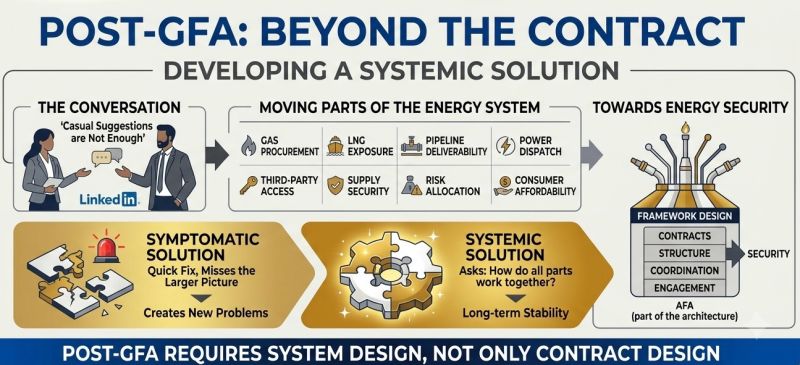
AFA Is One Part, Not the Full Answer
My friend then raised Automatic Fuel Adjustment, or AFA, under the Incentive-Based Regulation framework.
AFA allows generation cost to reflect actual market conditions. When fuel prices or exchange rates move, the adjustment may appear as a rebate or surcharge to consumers.
That is useful. But AFA alone is not the full answer. It is one part of the architecture. Post-GFA is not only about tariff adjustment. It is also about gas procurement, LNG exposure, pipeline deliverability, power dispatch, market conduct, third-party access, supply security, risk allocation and consumer affordability.
If we jump too quickly to one tool, we may solve one pain point but miss the larger system.
Symptomatic vs. Systemic Solutions
A symptomatic solution may ease one problem today but create another problem tomorrow.
A systemic solution asks a deeper question: how do all the moving parts work together?
Before proposing the final mechanism, we must first understand the pain points clearly, methodologically. This is why post-GFA requires system design, not only contract design.
AFA may become an important part of the solution. But it must sit within a wider framework that aligns fuel cost, dispatch behaviour, gas supply security, infrastructure access and tariff impact. Otherwise, we may have a mechanism that adjusts cost, but not a system that manages risk and supply security.
Energy security is not built by one instrument alone. It is built by structure, coordination, disciplined engagement and the humility to understand the system before rushing to solve it.