
Energy Systems & Infrastructure
The Pipeline Behind the Power Generation
In my earlier articles, I wrote about the Gas Framework Agreement, post-GFA, and why gas-fired power plants are no longer just about megawatts.
This time, I want to talk about something less visible, but just as important: the pipeline.
I started my career in 1998 as a Gas Control Engineer at PETRONAS Gas Control Centre, or PGCC, in Segamat, Johor.
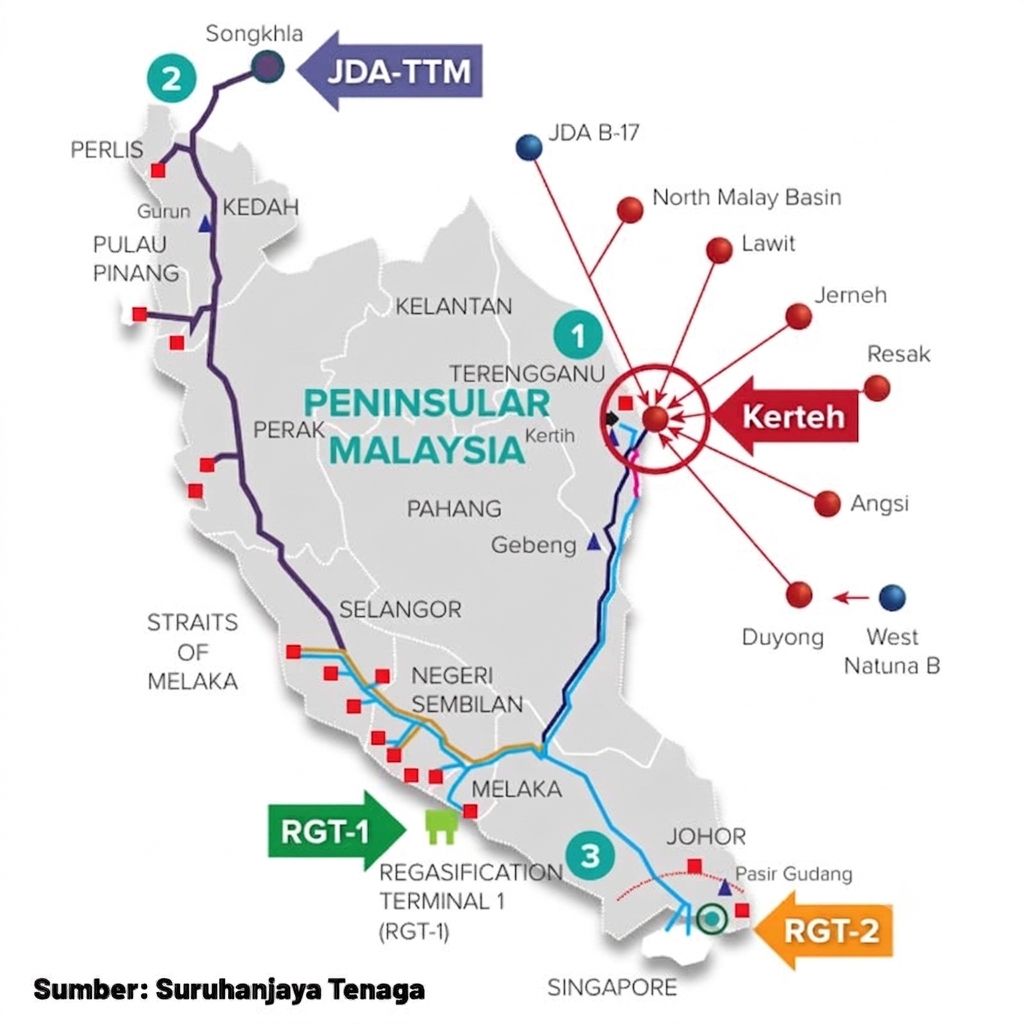
On paper, it is a gas transmission network. But to those who have worked close to it, Peninsular Gas Utilisation, or PGU, is more than steel pipes on a map. It is the backbone that connects gas processing, power plants, petrochemical plants and industries.
A Backbone That Grew With the Country
The history of PGU is closely tied to Malaysia's economic development. Natural gas from offshore fields had to be processed, transported and delivered to where the country needed energy. Power plants needed fuel. Industries needed reliable supply. Petrochemical facilities needed feedstock. The economy needed energy security.
So the pipeline system grew with the country. From the east coast, the gas network expanded across the peninsula. It connected production and processing centres with demand centres.
At PGCC, one learns very quickly that gas transportation is not passive. Gas does not simply "flow" because a contract says so. It has to be monitored, balanced, scheduled, controlled and protected.
Gas pressure matters. Demand matters. Compressor availability matters. Pipeline constraints matter. Maintenance matters. Power plant dispatch matters.
Why Deliverability Belongs in the Post-GFA Discussion
This is why, when we talk about GFA or post-GFA, we cannot talk only about gas supply contracts. We must also talk about deliverability. That is where PGU becomes central to the post-GFA discussion.
In the post-GFA era, Malaysia is looking at a more open and competitive gas market, including Third Party Access. TPA allows qualified shippers to access gas infrastructure under a regulated framework. In principle, it can support competition, market efficiency and new supply sources.
But access must not be seen only as a commercial right. It is also an operational responsibility. A shipper may have gas. A generator may need fuel. A contract may be signed. But the pipeline system must still be able to deliver.
Infrastructure Makes It Real
The lesson I carried from PGCC is simple. Energy security is not built only in a meeting room or at a negotiation table. It is also built in the control room, in the compressor station, along the right-of-way, at the metering station — inside the daily discipline of keeping gas moving safely and reliably.
The public may not see PGU. They may not see the control screens in Segamat. But they feel the outcome. When the light comes on. When the factory runs. When the hospital operates. When the country moves.
That is why post-GFA is not only about who sells gas. It is about how the whole gas-to-power chain continues to work.
Contracts matter. Markets matter. But infrastructure makes them real.