
Gas Market & Policy
Malaysia's First TPA Gas Shipper
When Malaysia embarked on the Third Party Access (TPA) journey, I had the privilege of being part of the team that established Malaysia's first licensed Gas Shipper under the TPA framework, PETRONAS Energy & Gas Trading (PEGT).
One of my responsibilities was leading the operations teams and managing the novation of commercial agreements from PETRONAS to PEGT. This involved extensive engagements with customers and other stakeholders.
It was a tough assignment.
Not merely because the agreements had to be transferred properly, but because almost nobody knew PEGT. More importantly, very few understood what a Gas Shipper was or how Third Party Access was supposed to work.
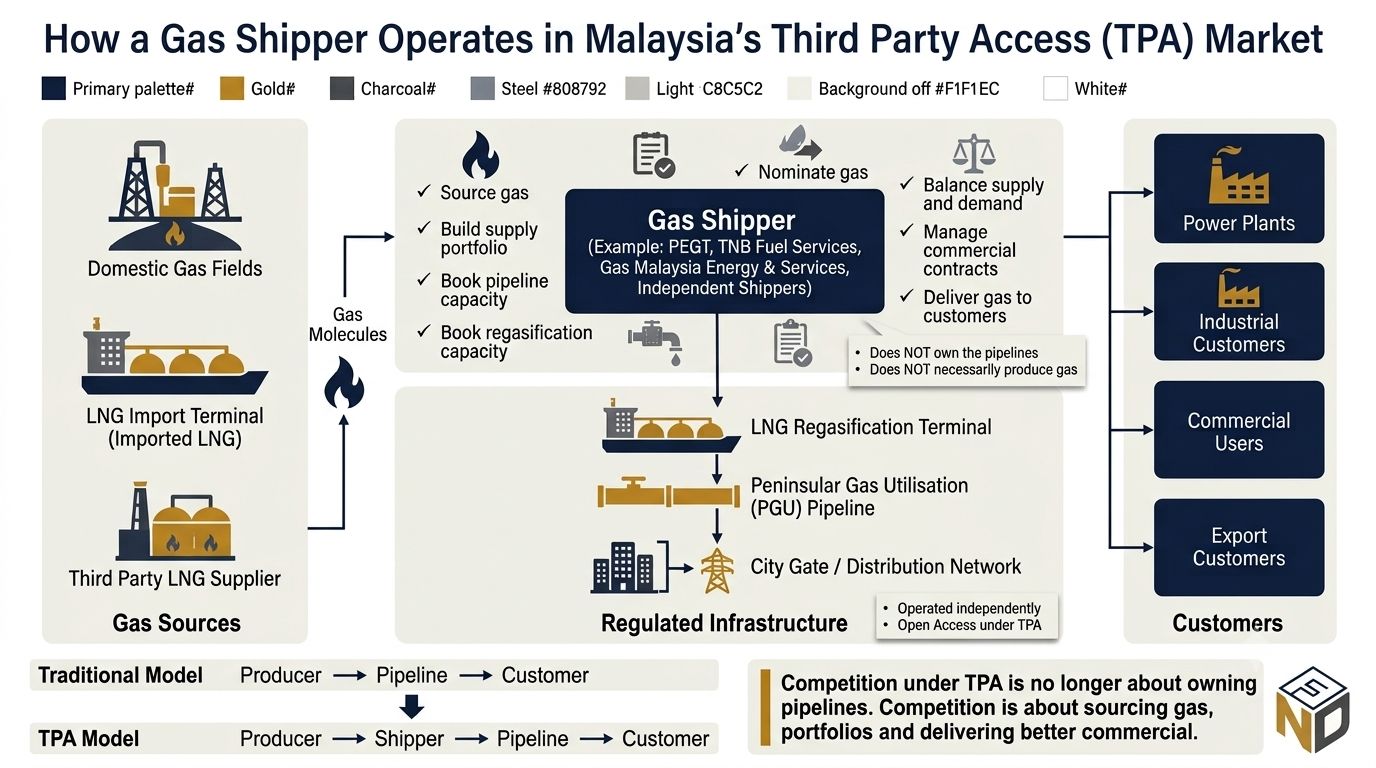
Why TPA Separates the Roles
Under the traditional integrated model, the same organisation could be involved in sourcing, transporting and selling gas. TPA separates these functions so that different suppliers can access common infrastructure under regulated terms.
The pipeline operator manages the infrastructure. The Gas Shipper manages the commercial movement of gas through it.
A shipper sources gas from domestic producers, LNG portfolios or other suppliers. It books transportation and regasification capacity, submits gas nominations, manages balancing obligations, administers supply contracts and ensures that the required quantity reaches the customer.
In simple terms, if the gas pipeline is a highway, the shipper is the logistics planner. It determines what enters the network, how much is transported, where it is delivered and how supply commitments are fulfilled. Its real strength lies in portfolio management.
From One Shipper to a Market of Shippers
Today, PEGT is no longer the only licensed shipper in Malaysia. Other licensed participants include companies associated with the power sector, international energy companies, gas retailers and independent energy players.
Customers are no longer expected to depend solely on whoever owns the infrastructure. In principle, different shippers can compete to supply gas through the same regulated network.
But the number of licensed shippers alone does not determine whether a market is truly competitive. Some may have licences but limited supply portfolios. Some may focus on specific customers or market segments. Others may have stronger access to LNG, domestic gas, infrastructure capacity or credit support.
The real competition is therefore not about who owns the pipeline. It is about who can build the most resilient portfolio, manage uncertainty and provide reliable gas at a commercially sustainable price.
The Deeper Purpose of TPA
Infrastructure should remain open and regulated. Competition should take place in sourcing, portfolio optimisation, commercial innovation and customer service. Shippers connect those molecules to markets.
And good market design determines whether competition exists only on paper, or delivers real value to customers.