
Gas Market & Policy
AQPS: The Quiet Innovation Inside Malaysia's Gas Framework Agreement
Electricity demand cannot be predicted perfectly.
Neither can rainfall, renewable generation, plant outages or fuel prices.
Yet a gas supplier cannot plan production, LNG imports and pipeline capacity based on "we'll take whatever the grid happens to need."
This was precisely the problem addressed by the Allocated Quantity to the Power Sector (AQPS) under Malaysia's Gas Framework Agreement (GFA).
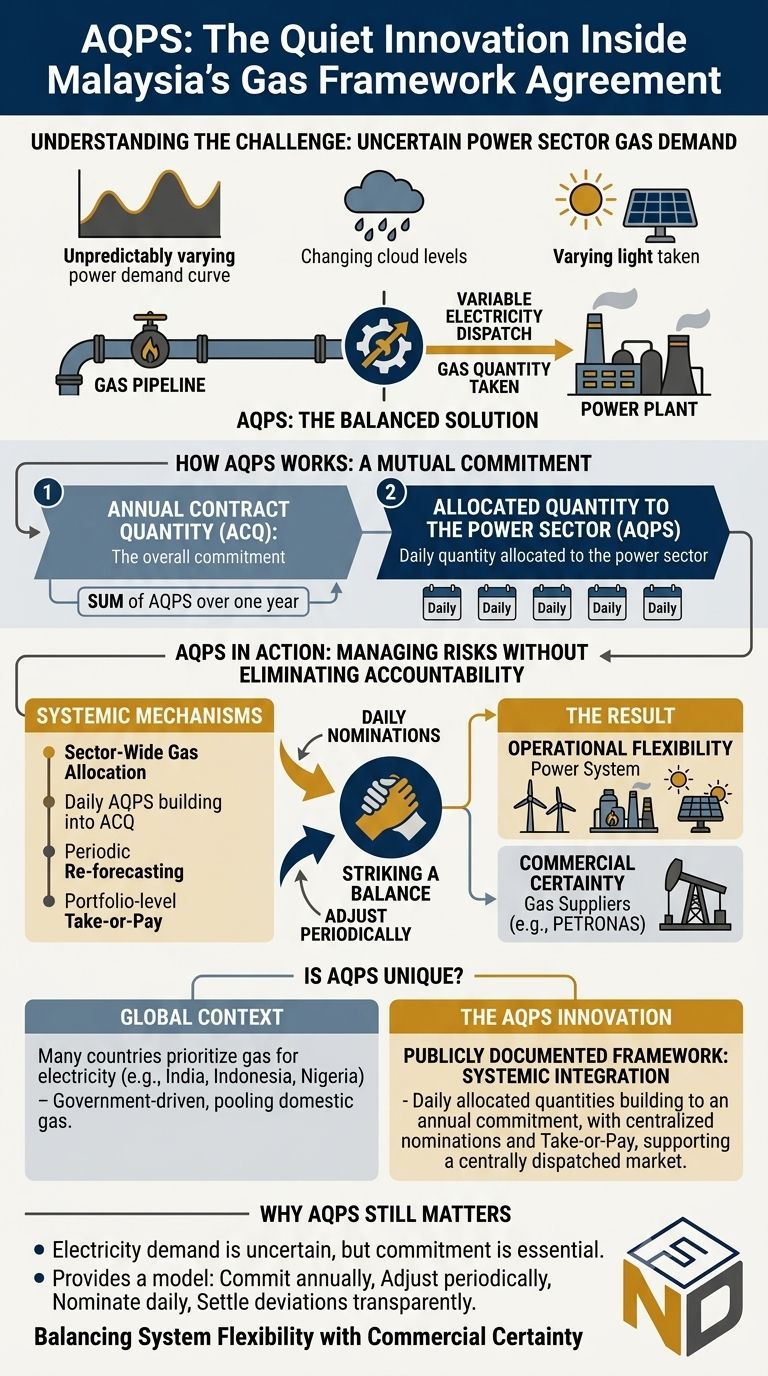
AQPS is the daily quantity of gas allocated to the power sector, while the Annual Contract Quantity is simply the sum of AQPS over an entire year.
Managing Uncertainty Without Eliminating Accountability
At first glance, AQPS appears to be another gas nomination mechanism. In reality, it solves a much bigger problem: managing uncertainty without eliminating accountability.
The Single Buyer decides which plants are dispatched to meet electricity demand. Those dispatch decisions determine how much gas the power sector consumes. This means gas demand changes constantly as electricity demand, generation mix, outages and system conditions evolve.
A fixed annual gas commitment would be too rigid. Complete flexibility would transfer almost all demand risk to the gas supplier. AQPS strikes a balance between both.
However, flexibility does not mean zero commitment. The power sector must still take a certain percentage of the net ACQ under the Take-or-Pay provision.
The result is simple. The power system retains operational flexibility. PETRONAS receives a commercially credible demand commitment.
Is AQPS Unique?
Many countries prioritise domestic or regulated gas for electricity generation. India pooled domestic gas and LNG to support gas-fired power plants. Indonesia allocates domestic gas to the power sector under government policy. Nigeria imposes domestic gas supply obligations for electricity generation.
However, I have not found another publicly documented framework combining all these features into a single market design, i.e. systemic: sector-wide gas allocation, daily allocated quantities building into an annual contractual commitment, periodic re-forecasting and mutual confirmation, and centralised nominations with portfolio-level Take-or-Pay obligations.
None of these mechanisms is individually new. The innovation lies in how they were integrated to support a centrally dispatched electricity market.
Why AQPS Still Matters
AQPS recognised a fundamental truth: electricity demand is uncertain, but uncertainty cannot mean the absence of commitment.
AQPS provided that balance. Commit annually. Adjust periodically. Nominate daily. Settle deviations transparently.
As Malaysia moves into the post-GFA era, the terminology may change. But the underlying challenge remains exactly the same.
How do we balance system flexibility with commercial certainty? That, in my view, is the real legacy of AQPS.