
Gas Market & Policy
From Gas TPA to Electricity TPA: Understanding CRESS
A friend asked, hence this article is written.
In one of my earlier articles, I wrote about Third Party Access (TPA) in the gas industry. Its objective was straightforward: the gas pipeline remains a common infrastructure, but more than one supplier can use it to deliver gas to customers.
Malaysia is now introducing a similar concept in the electricity sector through the Corporate Renewable Energy Supply Scheme (CRESS).
At first glance, CRESS sounds simple. A company wants to buy renewable electricity directly from a solar or renewable energy developer instead of purchasing everything from the traditional electricity supply arrangement.
But here is the interesting part. Electricity cannot be physically traced from one generator to one customer. Once electricity enters the national grid, it mixes with electricity from every other generator. The grid then continuously balances supply and demand in real time.
So how can a factory in Selangor claim it is buying electricity from a specific solar farm in Kedah?
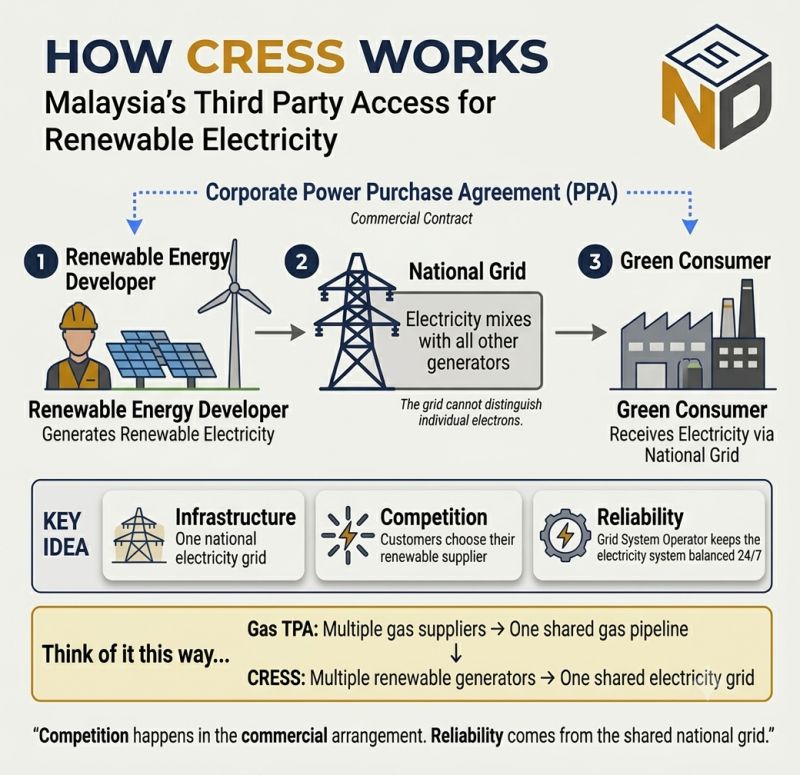
The Physical Reality of the Grid
The answer is that the contract and the physical delivery are two different things.
Commercially, the customer signs an agreement with the renewable energy developer. Physically, the electricity still flows through the national grid, while the System Operator ensures the grid remains stable and reliable.
This is why CRESS should not be viewed as bypassing the electricity system. Rather, it allows greater customer choice while continuing to rely on the existing grid as the common platform.
It is conceptually similar to how Gas TPA opened access to the gas pipeline without duplicating pipeline infrastructure. The competition takes place in the commercial arrangement, not by building parallel networks.
Same Philosophy, Greater Complexity
Of course, electricity is more complex than gas. The sun does not always shine, while factories continue operating around the clock.
Someone must still ensure sufficient generation reserves, maintain system frequency, balance intermittent renewable generation and keep the lights on.
That is why CRESS is not merely about allowing companies to buy renewable electricity. It is about finding the right balance between customer choice, market competition and system reliability.
The Bigger Lesson
As Malaysia gradually liberalises its energy sector, from Gas TPA to CRESS, we are seeing a common philosophy emerge: open access does not remove the need for system coordination. In fact, the more participants we introduce into the market, the more important that coordination becomes.
Perhaps that is the bigger lesson.
The future of energy is not simply about creating more competition. It is about designing market frameworks that allow competition to flourish without compromising the reliability of the system that everyone depends on.