
Gas Market & Policy
Order Amidst Complexity: The Background Behind the GFA
In my earlier post, I shared a personal reflection on the Gas Framework Agreement and why the current post-GFA discussion is timely. In this second note, I want to explain the background in simpler terms.
Gas supply to the power sector may sound straightforward. Gas is supplied. Power plants generate electricity. Consumers receive power. But in reality, it is a highly connected system.
Malaysia's gas supply to the power sector began as part of a national development agenda. Gas supported electricity reliability, industrial growth and affordable power.
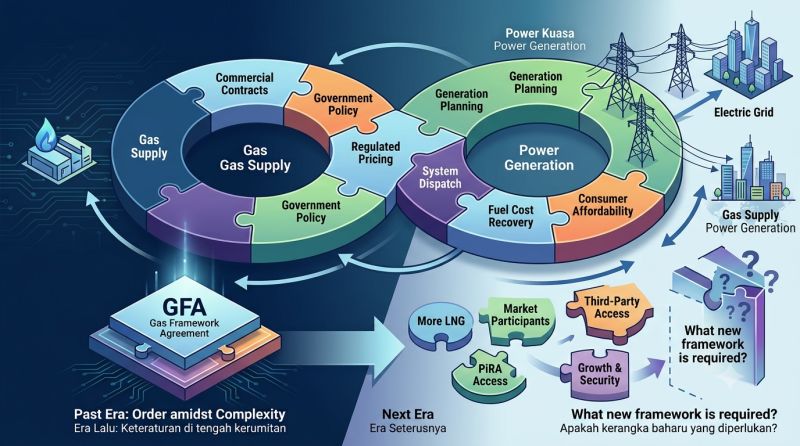
Layers That Created Complexity
As the country grew, the power sector became more complex. Electricity demand increased. Independent Power Producers entered the system. Power purchase arrangements became more sophisticated. Gas supply arrangements also had to evolve.
Over time, many layers came together: commercial contracts, government policy, regulated pricing, generation planning, system dispatch, fuel cost recovery and consumer affordability. Each layer had its purpose. But together, they created complexity.
The main challenge was this: gas supply and electricity dispatch do not always move neatly together.
A gas supplier must plan supply. A power plant must be ready to generate. But the electricity system decides which plant runs, when it runs, and how much it generates. So actual gas consumption depends not only on contract, but also on demand, plant availability, dispatch decisions, fuel cost and system conditions.
The Loose Ends the GFA Addressed
This is where the loose ends appeared. How do we plan gas volume when power demand changes? How do we manage supply commitments when dispatch is centrally decided? How do we price gas fairly when electricity must remain affordable, but supply cost is also changing?
These were not small technical questions. They were structural questions.
This was the background that made the GFA important. The GFA was not just another agreement. It was a framework to bring order to a system that had become complex over time. It recognised that gas-to-power is not a set of isolated contracts. It is one connected system.
A dispatch decision affects gas demand. A supply constraint affects generation reliability. A pricing decision affects commercial sustainability and consumer affordability.
What the Next Era Requires
Now Malaysia is entering another phase. The post-GFA mechanism must deal with greater LNG dependence, more market participants, infrastructure constraints, demand growth and the need to keep electricity affordable.
The question is not simply whether the old model should continue. The better question is: what kind of framework does the next era require?
Energy security is not secured by fuel alone. It is secured by structure, coordination and discipline.
Reference: Suruhanjaya Tenaga Consultation Paper — "Gas Supply to the Power Sector Post Gas Framework Agreement (GFA): Consultation on Future Market Arrangements for Uncontracted Gas Volumes in Peninsular Malaysia."