
Gas Market & Policy
Electricity Bills: Who Pays for Growth?
There has been a lot of discussion lately about electricity bills in Malaysia.
Some feel their bills have gone up. Others point out that the average RP4 base tariff was set at 45.40 sen/kWh, lower than the 45.62 sen/kWh initially approved.
Both can be true.
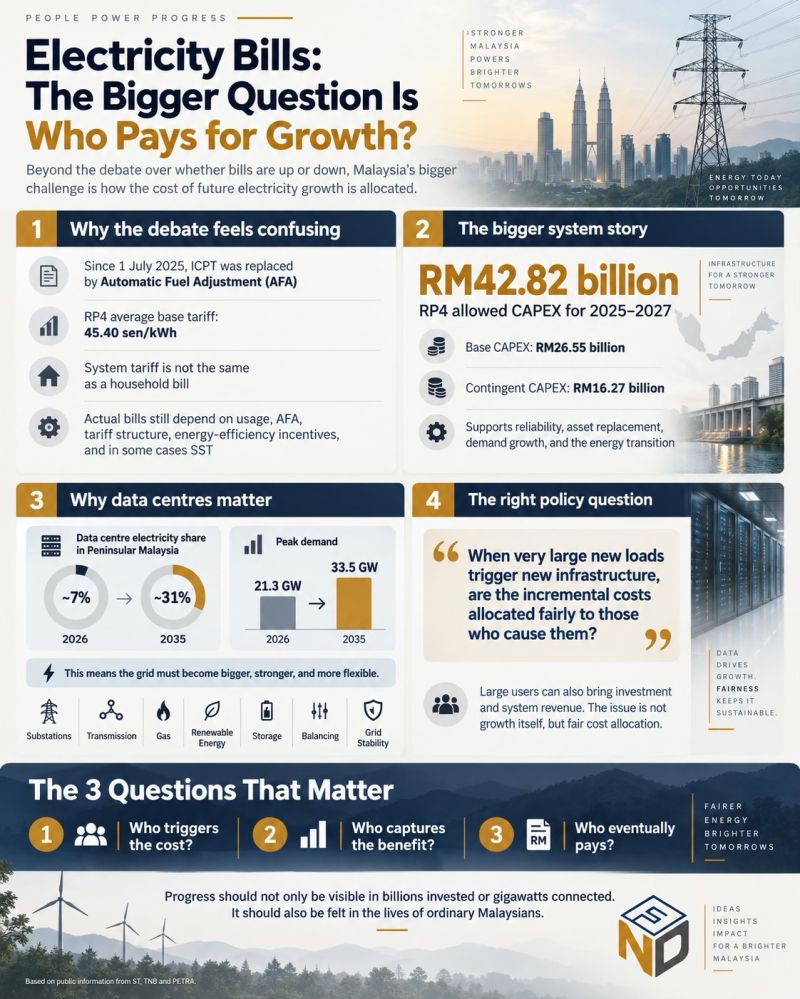
Since 1 July 2025, ICPT was replaced by the monthly Automatic Fuel Adjustment (AFA). More importantly, the average base tariff is not the same as what an individual household eventually pays.
But beyond the tariff debate, I think there is a bigger question.
Malaysia is preparing its power system for much higher future demand.
Under RP4, TNB has up to RM42.82 billion of allowed CAPEX for 2025 to 2027: RM26.55 billion in base CAPEX and RM16.27 billion in contingent CAPEX.
This is not simply “for data centres”. It also supports system reliability, asset replacement, demand growth and the energy transition.
Still, data centres are becoming an important part of the story.
PETRA projects their electricity consumption could rise from about 7% of Peninsular Malaysia’s total in 2026 to 31% by 2035. Over the same period, peak demand is projected to increase from 21.3 GW to 33.5 GW.
That means we need more than generation: substations, transmission, gas, renewable energy, storage, balancing and a grid capable of carrying much larger concentrated loads reliably.
This is where the conversation needs to become more precise.
It is too simplistic to say:
“Electricity bills are rising because of data centres.”
Large users also pay tariffs, network charges and, in some cases, connection-related infrastructure costs. They can also improve grid utilisation and create additional system revenue.
The better question is:
When a very large new load triggers additional infrastructure, how much of that incremental cost should be borne by the party creating it?
A 500 MW or 1 GW load appearing in one location may require new substations, stronger transmission and additional firm capacity. All of that has a cost.
Malaysia should welcome data-centre investment. It can strengthen our digital economy, AI ecosystem and regional competitiveness.
But investment value should not be measured only by the headline number.
We should also ask how much high-value employment is created, how much local capability grows, how much technology is anchored here and whether the economic value created is proportionate to the energy and infrastructure committed.
For me, this is the larger policy test:
Who triggers the cost? Who captures the benefit? Who eventually pays?
A stronger grid matters. Investment matters. Data centres matter. The energy transition matters.
But a good energy system must also keep electricity reliable, competitive and affordable.
Progress should not only be visible in billions invested or gigawatts connected.
It should also be felt in the lives of ordinary Malaysians.
Free Briefing
Malaysia Gas Market Reform: A Leadership Briefing
The end of the Gas Framework Agreement, Third Party Access, gas shippers and CRESS in one read, with ten questions for your leadership team.
Working Through a Similar Question?
Energy Systems Advisory helps leaders understand how market, regulatory and commercial changes affect the wider gas system before a decision is made.
Newsletter
Get New Insights by Email
Analysis of gas markets, energy systems and strategy, sent when a new article is published.
Or subscribe directly on Substack.