
Energy Systems & Infrastructure
Design the System, Not Just the Agreement
In my earlier posts, I reflected on why the Gas Framework Agreement (GFA) was introduced and the industry context that shaped its role. I also shared why the current post-GFA consultation is an important opportunity to rethink the future, not simply replace an existing arrangement.
This next discussion naturally follows that conversation.
The question is no longer just who should supply gas to the power sector? It is how should the entire gas-to-power system be designed?
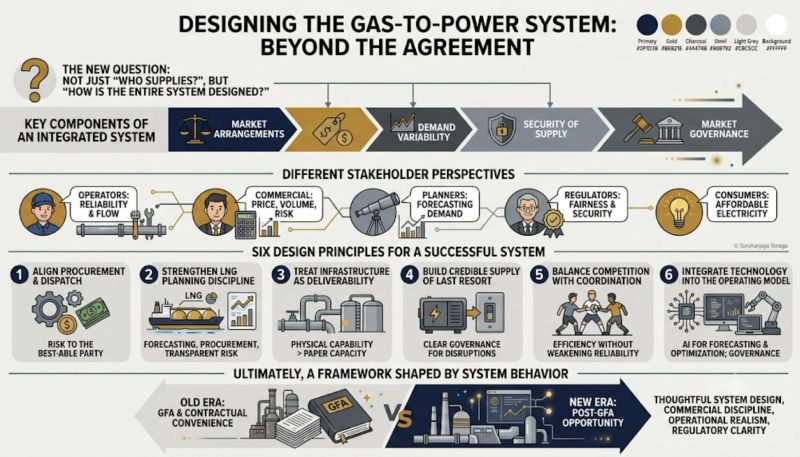
The recent consultation by Suruhanjaya Tenaga rightly broadens the discussion to market arrangements, pricing, demand variability, security of supply and market governance. These are not separate issues. They are components of one integrated system.
Every Stakeholder Sees the System Differently
Having spent many years across gas operations, production planning, gas marketing, contract negotiation, trading, infrastructure and business strategy, and now technology and digital commercialisation, one lesson stands out: gas-to-power is never just about contracts. It is about system design.
Every stakeholder sees the system differently. Operators focus on reliability, pressure and flow. Commercial teams manage price, volume and contractual risk. Planners forecast future demand and capacity. Regulators safeguard fairness and security of supply. Consumers simply expect electricity that is reliable and affordable.
A successful post-GFA framework must reconcile all these perspectives.
Six Design Principles
To me, six design principles deserve attention.
- Align gas procurement with electricity dispatch. Risk should reside with the party best able to manage it.
- Strengthen LNG planning discipline. Greater LNG dependence requires better forecasting, structured procurement and transparent risk allocation.
- Treat infrastructure as deliverability, not paper capacity. Physical capability matters more than theoretical capacity.
- Build a credible Supply of Last Resort mechanism. Clear governance is essential when supply disruptions occur.
- Balance competition with coordination. Commercial efficiency should never weaken system reliability.
- Make technology part of the operating model. AI can strengthen forecasting, optimisation and early warning, but only when supported by sound governance and clear accountability.
A Framework Shaped by System Behavior
Ultimately, the post-GFA framework should not be shaped by organisational preferences or contractual convenience. It should reflect how the gas-to-power ecosystem actually behaves.
The original GFA addressed the challenges of its era. The new system should be designed through thoughtful system design, commercial discipline, operational realism and regulatory clarity.
That, perhaps, is the real opportunity of the post-GFA era.