
Energy Systems & Infrastructure
Data Centres: The Cost Begins Before Consumption
A data centre may consume electricity only after it opens.
The power system begins spending much earlier for the new substations, transformers, transmission connections and additional generation capacity. Some of these assets take years to build and will remain in the system for decades.
This brought me back to my yesterday reflection on where energy-transition promises meet system capability.
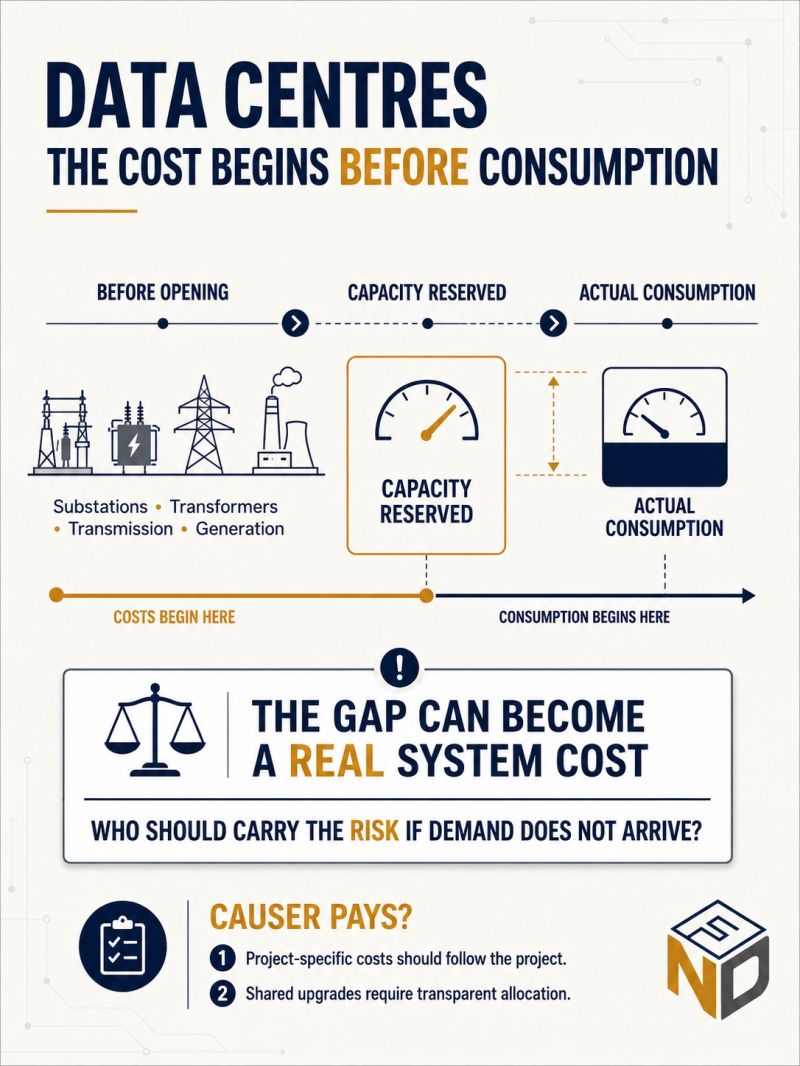
A data centre may secure a large electricity capacity. But secured capacity and actual consumption are two different things.
If utilisation grows as projected, the early investment may prove necessary.
But what happens if the project is delayed, scaled down or never reaches the capacity requested?
Who should carry that risk? Malaysia appears to be moving towards a “causer pays” approach.
In a recent interview, the Energy Commission’s CEO explained that data-centre developers may be required to fund project-specific network upgrades upfront and make annual capacity commitments resembling take-or-pay arrangements.
Conceptually, this seems reasonable.
If a particular project requires dedicated infrastructure, it may not be fair for the wider body of electricity consumers to carry all the risk if that demand does not materialise.
But “causer pays” is easier to state than to design.
Some infrastructure may be built specifically for one data centre. Other upgrades may strengthen the wider network and serve future consumers. Separating the two requires careful technical and commercial judgment.
There are several questions worth considering in terms of calculation of the cost to be charged and commitment on ramp-up rate of actual demand.
There is also a wider system question.
A renewable-energy contract may help a data centre meet its sustainability commitments. But it does not, by itself, remove the need for transmission, balancing and firm supply when solar output is unavailable.
Malaysia should welcome data centres that create meaningful economic value, strengthen our digital ecosystem and support higher-value activities.
My humble view is that welcoming investment does not require the public to absorb every infrastructure risk behind it.
At the same time, the framework should be transparent and predictable. Genuine investors need to understand what they are paying for, why they are paying and how the obligation will change as actual demand develops.
Perhaps the more mature question is no longer simply “How many megawatts of data centres have been approved?”
But “How much of that demand is firm, what must be built to serve it and who should carry the risk if it does not arrive?”
Because capacity reserved is not yet electricity consumed. But the cost of preparing for it can already be incurred.
Working Through a Similar Question?
Energy Systems Advisory helps leaders see the supply, demand and infrastructure dependencies behind a decision, and where the risk sits.
Newsletter
Get New Insights by Email
Analysis of gas markets, energy systems and strategy, sent when a new article is published.
Or subscribe directly on Substack.