
Energy Systems & Infrastructure
Malaysia's Data Centre Opportunity Calls for Better Infrastructure Thinking
Almost every week, we see encouraging announcements of new data centre investments in Malaysia.
Billions of ringgit. Thousands of GPUs. A growing ambition to position Malaysia as an important AI hub in ASEAN.
These developments are worth welcoming. At the same time, they may invite us to consider a broader question.
Not only:
“How many data centres can Malaysia build?”
But also:
“How much supporting infrastructure can Malaysia sustain?”
Throughout my career, working across gas infrastructure, fibre connectivity and market frameworks, one lesson has repeatedly become clear to me:
Infrastructure often determines the ceiling of economic growth.
When most people see a data centre, they understandably see a major investment.
I tend to see the wider ecosystem around it.
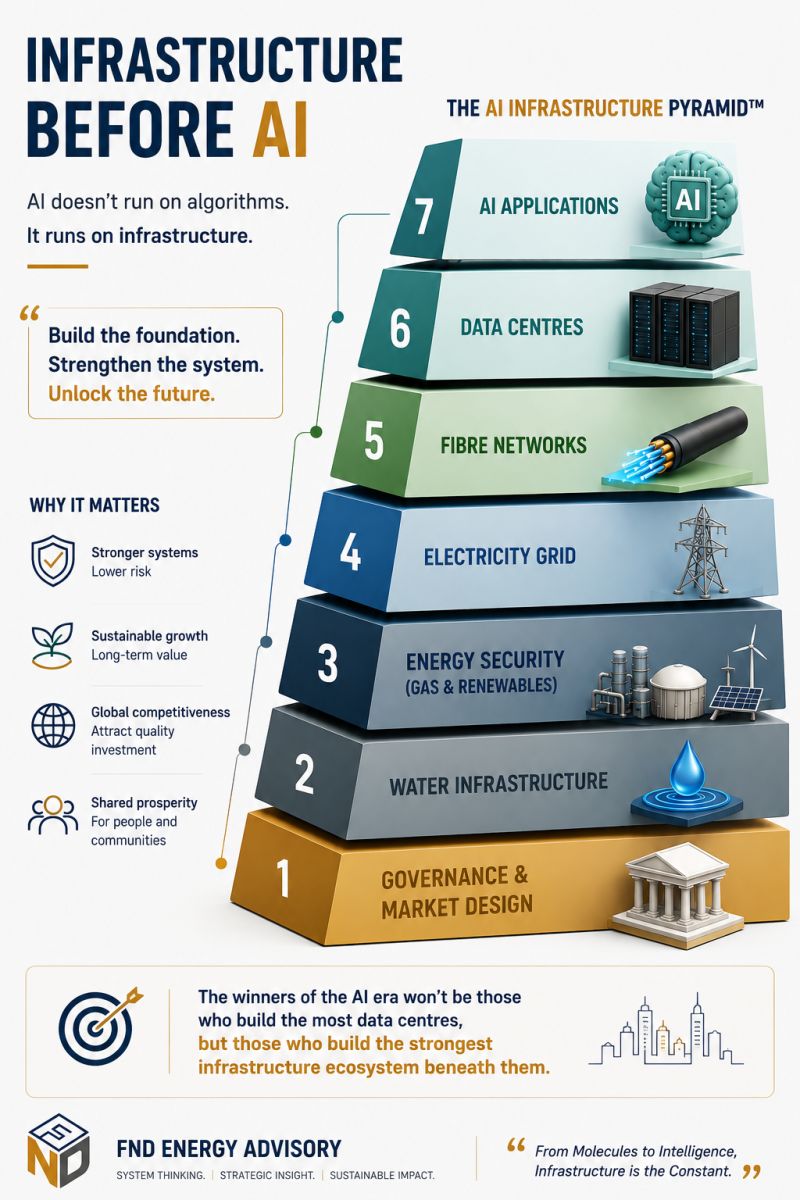
A modern AI economy depends on several interconnected foundations:
- Reliable electricity with sufficient reserve capacity.
- Resilient transmission and distribution networks.
- High-capacity fibre connectivity.
- Sustainable water supply and cooling solutions.
- Land, logistics and permitting that can keep pace with investment.
- Market rules that offer investors certainty while safeguarding national interests.
When one layer is under strain, the layers above it may also become more vulnerable.
This is why I have often returned to the idea of System Thinking Before Market Thinking.
Strong demand alone may not be enough. The supporting system must also be designed to grow safely, efficiently and sustainably.
The same applies to AI.
AI does not only require computing power and electricity. It depends on an entire infrastructure ecosystem.
Malaysia is fortunate to have several genuine advantages: natural gas, expanding renewable-energy capacity, a growing fibre backbone, strategic geography and an increasingly mature regulatory landscape.
The task now is to build on these strengths carefully.
That may require us to look beyond individual project approvals and consider how energy, connectivity, water, land and regulation can be coordinated so that each investment strengthens the next.
Perhaps one of my earlier principles can be extended:
From Infrastructure Before Molecules…
…to Infrastructure Before AI.
The countries that lead the AI era may not necessarily be those with the largest number of data centres.
They may be those that build the most resilient, efficient and sustainable infrastructure ecosystem beneath them.
That, perhaps, is where Malaysia’s lasting competitive advantage can be created.
Working Through a Similar Question?
Energy Systems Advisory helps leaders see the supply, demand and infrastructure dependencies behind a decision, and where the risk sits.
Newsletter
Get New Insights by Email
Analysis of gas markets, energy systems and strategy, sent when a new article is published.
Or subscribe directly on Substack.