
Energy Systems & Infrastructure
A 1.5 GW Data Centre Is Not Just a Data Centre Investment
DayOne and TNB Power Generation will explore up to 1.5 GW of on-site generation for a new data-centre development in Selangor.
Large energy figures can be difficult to visualise. Peninsular Malaysia’s peak demand in 2025 was about 21 GW. At 1.5 GW, this development would be equivalent to around 7% of the entire system peak.
Closer to home, Melaka recorded a peak electricity demand of 1,504 MW in 2019. The generation capacity being considered for this one development is therefore almost equivalent to the peak demand of an entire state.
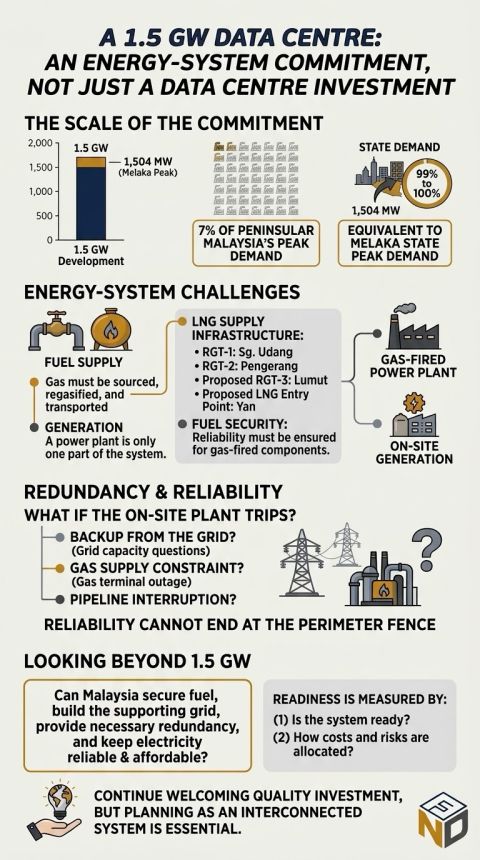
That puts the investment in a different perspective.
A data centre is a technology investment. At this scale, however, it is also an energy-system commitment.
A power plant is only one part of that system. If gas-fired generation eventually forms part of the solution, the fuel behind the power must also be secured. Gas has to be sourced, regasified, transported through the PGU network and delivered reliably to the plant.
This is why recent LNG infrastructure developments are relevant. Peninsular Malaysia has RGTs at Sungai Udang and Pengerang, with capacities of around 500 MMscfd and 490 MMscfd. RGT-3 at Lumut is designed to add another 500 MMscfd. Gas Malaysia, Tokyo Gas and VTTI are also proposing an LNG entry point at Yan, Kedah, with capacity of up to 6 MTPA.
Together, these developments suggest a larger picture: data-centre growth is increasingly becoming an energy-system question.
There is also the question of redundancy. On-site generation may reduce pressure on the grid, which is positive. But if the plant trips, what provides the backup? If that role falls to the grid, how much generation and transmission capacity must remain available? What happens during a gas-supply constraint, terminal outage or pipeline interruption?
A data centre may generate its own electricity, but reliability cannot end at its perimeter fence.
This connects with themes I have explored recently: the cost that begins before consumption, additional LNG infrastructure and the importance of planning energy transition as one interconnected system.
Perhaps we should look beyond whether Malaysia can supply 1.5 GW. We should also ask whether we can secure the fuel, build the supporting grid, provide the necessary redundancy and still keep electricity reliable and affordable for other consumers.
Malaysia should continue welcoming quality data-centre investment. The opportunity is significant.
My modest observation is that readiness at this scale is not measured by the data centre alone. It is measured by whether the system around it is ready and by how clearly its costs and risks are allocated.
Working Through a Similar Question?
Energy Systems Advisory helps leaders see the supply, demand and infrastructure dependencies behind a decision, and where the risk sits.
Newsletter
Get New Insights by Email
Analysis of gas markets, energy systems and strategy, sent when a new article is published.
Or subscribe directly on Substack.