
Governance & Public Trust
When Decisions Never Leave The Meeting Room
Why are Malaysians talking about eFishery?
Because KWAP invested RM163.4 million in the company. This is not merely a private venture-capital loss. KWAP manages public-sector retirement funds. When public money is exposed, the public has the right to ask: what was examined, who challenged the assumptions, and what was independently verified on the ground?
The lesson goes far beyond one investment.
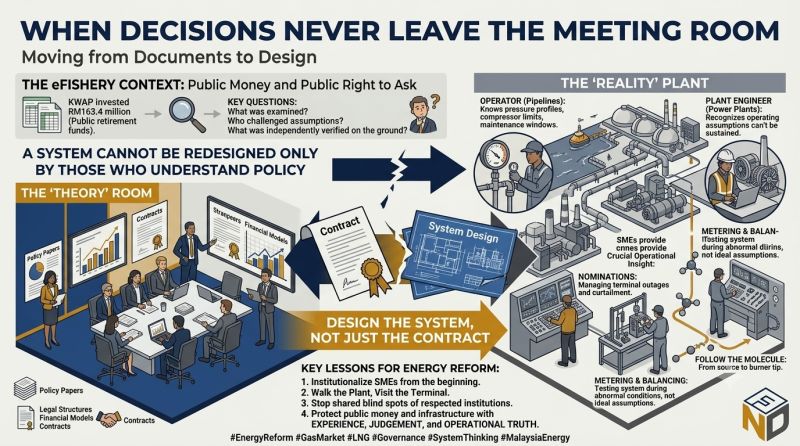
We Need System Change, Not Just New Contracts
In my earlier writings on the post-GFA environment, gas allocation, third-party access, LNG infrastructure and electricity-market reform, I have argued that Malaysia does not simply need new contracts.
We need system change.
But a system cannot be redesigned only by those who understand policy papers, legal structures and financial models. The people who have operated it must also be in the room.
Energy decisions require subject-matter experts who have worked with pipelines, compressors, LNG terminals, power plants, dispatch, maintenance shutdowns, nominations, balancing, metering and emergency response.
Not merely as technical reviewers after the commercial structure has been decided. They must be involved from the beginning.
The Difference Between the Numbers and the System
A spreadsheet may show available capacity.
An operator may know that pressure profiles, compressor limitations or maintenance windows make that capacity unreliable.
A contract may promise gas delivery.
Someone with operational experience will ask what happens during upstream curtailment, a terminal outage, pipeline congestion or a sudden rise in power demand.
A financial model may show an attractive return.
A plant engineer may recognise that the operating assumptions cannot be sustained.
That is the difference between understanding the numbers and understanding the system that produces them.
The Shared Blind Spot
The danger is not only fraud. It is decision-making that becomes too comfortable in the meeting room.
When prominent advisers, investors or institutions are involved, people assume someone else has tested the difficult questions. But respected institutions reviewing the same flawed information do not create independent truth. They may simply create a shared blind spot.
Institutionalise the Role of Experienced SMEs
This is why the next phase of Malaysia's energy reform must institutionalise the role of experienced SMEs.
Walk the plant. Visit the terminal.
Speak to control-room operators.
Test the system during abnormal conditions, not only under ideal assumptions.
Follow the molecule from source to burner tip.
We do not need fewer economists, lawyers, financiers or consultants.
We need them working alongside people who know what happens when the model meets the machinery.
Major decisions involving public money and national infrastructure should never be protected by documents alone.
They must be protected by experience, judgement and operational truth.
Design the system, not just the contract.