
Governance & Public Trust
Accountability Begins With Control: The RACI Framework
In my earlier article on TNB’s post-GFA study, I shared a question raised by a friend over lunch.
“Who should be accountable for the whole system?” My response was another question. “Who is actually in control?”
I believe this is an important question, particularly when dealing with complex systems involving multiple organisations.
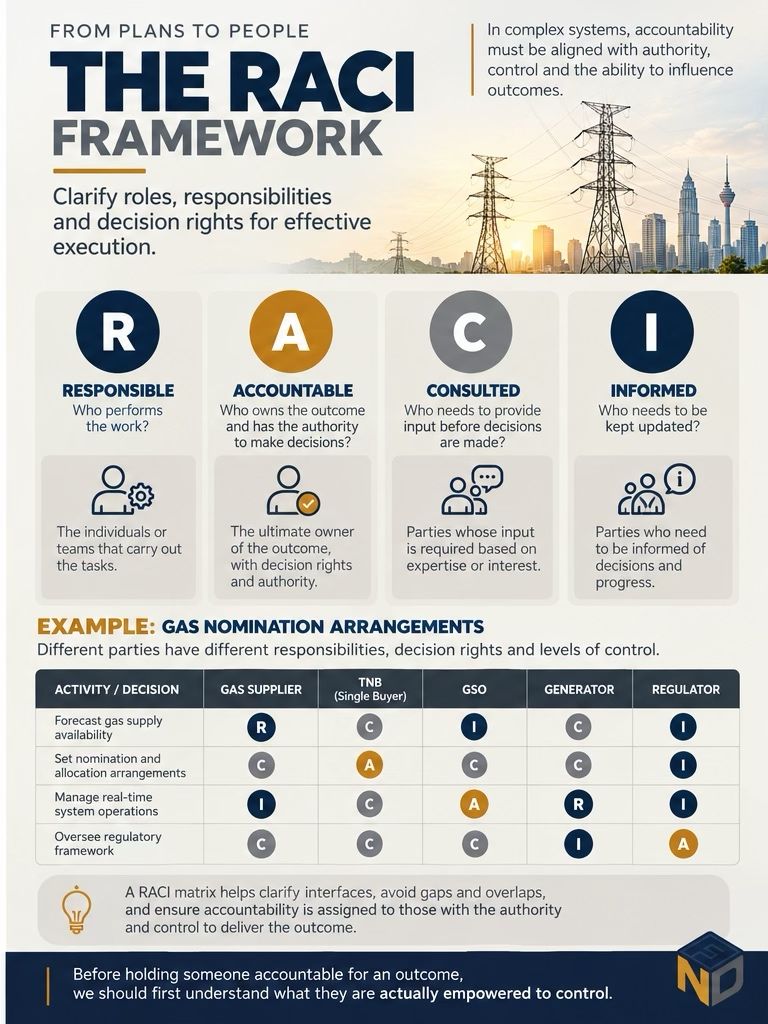
In my previous article, I explained how I use the 5M framework to translate strategies into tactical plans.
Once we know what needs to be done, the next challenge is establishing who does what.
This is where I find RACI useful.
RACI stands for:
- R, Responsible: Who actually performs the work?
- A, Accountable: Who owns the outcome and has the authority to make the necessary decisions?
- C, Consulted: Who needs to provide input before decisions are made?
- I, Informed: Who needs to be kept updated on decisions and progress?
Let me use the electricity supply system again.
Consider a proposed improvement to gas nomination and allocation arrangements under the post-GFA framework.
The gas supplier may manage supply availability. The Single Buyer has electricity procurement responsibilities. The Grid System Operator manages real-time system operations while the regulator oversees the regulatory framework.
Each party has its own responsibilities, authority and operational constraints.
A decision by one party may affect another party’s ability to perform.
For example, who should be accountable when a gas supply constraint affects electricity generation?
Is it the party supplying the gas, the party scheduling its use or the party managing electricity system operations?
The answer depends on the specific obligation, decision rights and circumstances.
This is why I prefer to understand the end-to-end system before assigning accountability.
A RACI matrix should be developed for specific activities and decisions, with clear accountability for each.
Otherwise, we may end up assigning accountability to someone who does not have sufficient authority or control over the outcome.
Equally important, having control over one part of the system does not automatically make someone accountable for the entire system.
Accountability should be aligned with authority, control and the ability to influence outcomes.
This is particularly relevant in regulated industries where responsibilities are distributed across different organisations.
RACI also helps identify gaps, overlaps and areas where coordination needs to be strengthened.
In my approach to SOSTAC, RACI comes into the Action stage, after the strategies have been translated into tactical plans using 5M.
RACI alone cannot solve organisational problems. Clear governance, effective communication and willingness to take ownership are equally important.
Before holding someone accountable for an outcome, we should first understand what they are actually empowered to control.
Working Through a Similar Question?
FND Energy Advisory works across energy systems advisory, strategy and commercialisation, strategic facilitation and capability development.
Newsletter
Get New Insights by Email
Analysis of gas markets, energy systems and strategy, sent when a new article is published.
Or subscribe directly on Substack.