
Governance & Public Trust
From Strategy to Execution: The 5M Framework
In my previous article on TNB’s post-GFA study, I shared how I use SOSTAC as a framework for systems thinking and strategic planning.
I briefly mentioned the 5M framework under Tactics. Perhaps it is worth explaining how I use it.
Over the years, I have learned that developing a strategy is often easier than translating it into something that can actually be implemented.
A strategy may look good on paper, but once we get into the operational details, things can become complicated.
This is where I find the 5M framework useful.
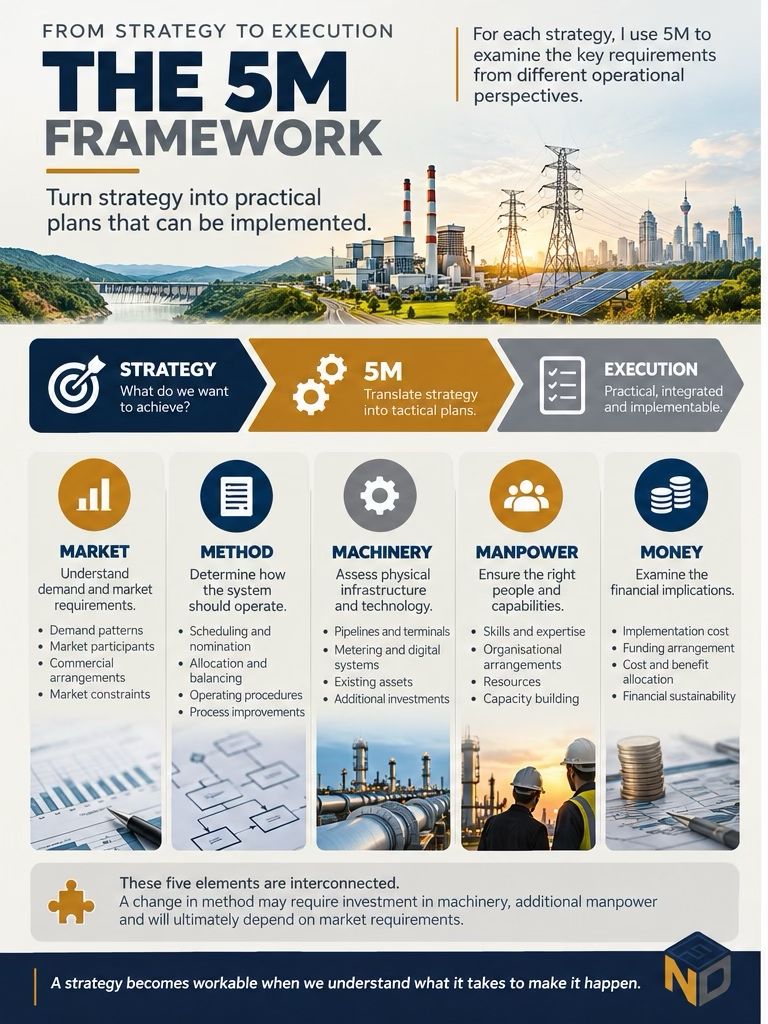
Market, Method, Machinery, Manpower and Money.
For each strategy identified, I would expand it into tactical plans covering these five elements.
Let me use the electricity supply system as an example.
Suppose one of our strategies for the post-GFA era is to improve gas supply flexibility for the power sector.
How would we translate this into practical arrangements?
1. Market
Understand the demand and market requirements.
How much flexibility does the power sector actually need? What are the demand patterns, commercial arrangements and market constraints?
2. Method
Determine how the system should operate.
What scheduling, nomination, allocation and balancing mechanisms are required? What existing procedures need to be improved?
3. Machinery
Assess the physical infrastructure and technology.
Can our pipelines, terminals, metering and digital systems support the proposed arrangements? Are additional investments necessary?
4. Manpower
Consider the people who will operate the system.
Do we have the necessary capabilities, resources and organisational arrangements? What skills need to be developed?
5. Money
Finally, examine the financial implications.
What will implementation cost? Who will fund the investments? How should the costs and benefits be allocated among the parties?
These five elements are interconnected.
For example, a proposed change in gas nomination procedures (Method) may require better digital systems (Machinery), additional operational capabilities (Manpower) and investment (Money).
All must respond to the actual requirements of the Market.
For me, this is the value of 5M. It encourages us to examine the practical requirements of each strategy before committing to implementation.
Of course, 5M is only a planning tool. The quality of the outcome still depends on how well we understand the system and the assumptions behind our decisions.
I have found this approach useful in various strategic and business development assignments, with adjustments depending on the nature of the business.
Once the tactical plans are established, another important question follows.
Who will do what, and who will be accountable for delivering the outcome?
That brings us to another tool I frequently use, RACI.
Perhaps something to share in my next article.
A strategy becomes workable when we understand what it takes to make it happen.
Working Through a Similar Question?
FND Energy Advisory works across energy systems advisory, strategy and commercialisation, strategic facilitation and capability development.
Newsletter
Get New Insights by Email
Analysis of gas markets, energy systems and strategy, sent when a new article is published.
Or subscribe directly on Substack.